DJ Shipley’s “Unbreakable” Routine for Mind and Body

Summary
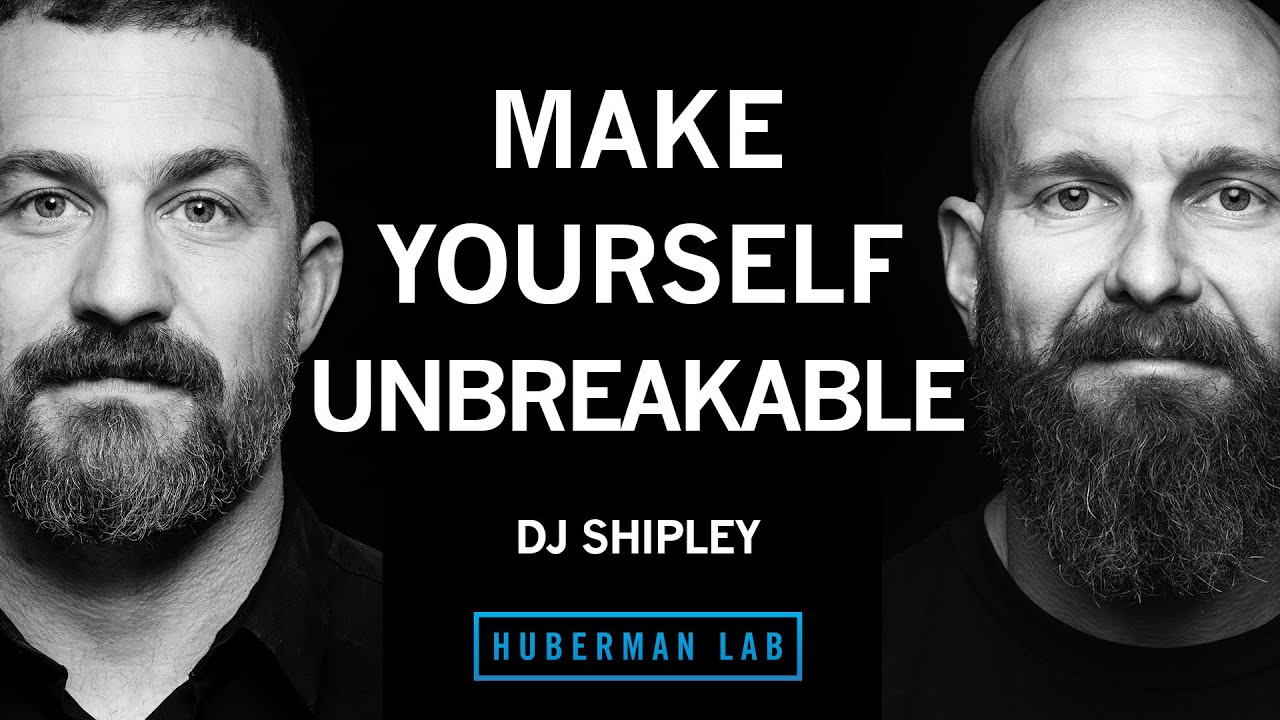
DJ Shipley’s core idea is blunt and practical, your mental state is highly context-dependent, so you must build the context on purpose. In this episode, he describes an “operator” approach to mental health that uses physical action, strict time blocks, and repeatable rituals to prevent rumination and keep you functional under stress. The centerpiece is a consistent 5:00 AM wake time, a 12-minute, pre-planned sequence that stacks “micro wins,” a protected 7:00 to 10:00 AM training block with no calls or social media, and a deliberate transition into family time that includes mental rehearsal and a nightly 20-minute walk.
The surprising “unbreakable” claim, routine as mental armor
One of the most striking details in this conversation is not a supplement or a workout split, it is the fear of what happens when the routine disappears.
Shipley describes going nearly two decades without taking five consecutive days off training when he was physically able, because he is “so afraid” his mental health will drop if he leaves that structure.
That is a very different framing than the usual “discipline equals toughness” slogan. The unique perspective here is that the routine is not a trophy. It is protective equipment.
In the episode, that protection is built from small, repeatable actions: a fixed wake time, a pre-set environment, a strict no-phone window, a training-first morning, and a deliberate transition into family life. The overall effect is to reduce franticness, reduce decision fatigue, and reduce the odds that a single negative input hijacks the entire day.
Did you know? A consistent wake time is strongly tied to more stable sleep rhythms. Sleep regularity is increasingly recognized as a meaningful health factor, not just total sleep hours. One large study linked irregular sleep patterns with higher cardiometabolic risk markers, even when total sleep time looked similar (JAMA Network OpenTrusted Source).
This article breaks down the specific rituals and timing he describes, then adds a small layer of supporting research so you can adapt the approach without turning it into a punishing performance contest.
A core premise, your mind is context-dependent
This framework starts with a humble admission: even highly trained people are not immune to emotional momentum.
The discussion repeatedly returns to the idea that a brain can “stick” to whatever it touches first. A negative comment, a rushed morning, a difficult conversation at the wrong time, or even a missing set of keys can cascade into an entire day of irritability and distraction.
Shipley’s solution is not to pretend he is unbothered. It is to engineer the context so fewer things can reach him at vulnerable moments.
That matters for everyday health because rumination and chronic stress are not only “in your head.” Ongoing stress is associated with sleep disruption, higher inflammatory signaling, and worse mental health symptoms in many people. Stress also tends to push behavior toward quick relief, which might mean doomscrolling, alcohol, or skipping exercise.
This view also explains why his routines look unusually strict. It is not rigidity for its own sake. It is an attempt to keep the mind from getting knocked off course before the day has even started.
Pro Tip: If you are trying to copy this approach, do not start by “optimizing everything.” Start by identifying the one time of day you are most likely to spiral (often the first 30 minutes after waking, or the first 30 minutes after getting home), then build a simple ritual for that window.
The evening routine that makes the morning possible
A hidden theme in the episode is that the morning routine is actually built the night before.
The practical detail is simple: clothes laid out, water bottle filled, toothbrush ready, supplements or pills set out, keys and wallet in a known place. When the alarm goes off, the goal is to move forward without negotiating with yourself.
This is less about willpower and more about removing friction.
In behavior science terms, changing the environment can be more reliable than trying to “feel motivated.” The easier a behavior is to start, the more likely it is to happen. That is why pre-commitment strategies, like staging your workout clothes, are commonly recommended in lifestyle programs.
A quick evening checklist you can borrow
Short routines win because they are repeatable.
Shipley’s 5:00 AM sequence, stacking micro wins in 12 minutes
The most concrete, uniquely “operator” part of the conversation is the description of a precise, repeatable sequence immediately after waking.
Alarm at 5:00 AM. Phone unplugged. Alarm off. Toothpaste on toothbrush. Bathroom. Brush teeth. Morning pills and vitamins (he mentions vitamin D among what he takes). Then dressing in a specific order, down to socks, shoes, and even bracelets in a set sequence.
If something is out of order, he restarts it.
That might sound obsessive until you understand the intention: he is proving to himself that he is not rushed, not under duress, and in control of the timeline. By the time coffee happens, he has already completed “25 things” that were within his control.
This is the “micro wins” concept. It is not about the size of the win. It is about building a momentum of completion before the world starts making demands.
Why this can work psychologically
A detailed way to interpret this is that it reduces two common drivers of morning stress:
The episode’s argument is that you do not need to be perfect. You need to be consistent.
Important: A fixed 5:00 AM wake time is not medically “better” for everyone. If you try a very early wake time but it chronically reduces your total sleep, you may feel worse over time. Many adults function best with at least 7 hours of sleep, and some need more. If you have insomnia, shift-work schedules, bipolar disorder, or a seizure disorder, it is especially wise to discuss major sleep changes with a clinician.
Why exercise is the keystone, especially after injury or low points
Shipley links his lowest mental health periods to losing his physical connection, especially when injured or post-surgery.
That detail is important because it reframes training. In this view, exercise is not only aesthetic or performance-driven. It is a stabilizer that can keep mood from collapsing.
He describes a pattern: when physical capacity dropped, mental health “rapidly declined.” As he rebuilt physically, his mental health “naturally” started to come back.
There is research support for the general direction of this claim. Exercise is associated with improvements in depressive symptoms and anxiety for many people, and it is often recommended as part of a broader mental health plan, not a standalone cure. A large umbrella review found consistent evidence that physical activity can be beneficial for symptoms of depression and anxiety across populations (British Journal of Sports MedicineTrusted Source).
The video’s unique angle, though, is not “exercise helps mood.” It is that exercise is used as an identity anchor. He wants to “unrack” at 7:00 AM as the best version of himself, because by mid-morning he will be pulled in many directions.
The morning training block described in the episode
The point is not that everyone needs that exact schedule. The point is the protected block where nothing else is allowed to intrude.
What the research shows: Morning light exposure and consistent timing cues can support circadian rhythms, which influence sleep, mood, and metabolism. Even a simple walk outdoors can help provide those cues (NIH, Circadian Rhythms Fact SheetTrusted Source).
The “to-not-do” list, social media, bad news, and bandwidth theft
A major part of the routine is subtraction.
He describes a past habit of rolling over in bed and opening Instagram, checking comments and engagement. If he saw something negative, he would “wear that jacket all day long.”
So he removes social media from the morning.
He also avoids Zoom calls, phone calls, and anything in his “orbit” before 10:00 AM. The protected morning block is treated like a psychological clean room.
This is also where his relationship boundaries show up in a very specific way. His spouse will sometimes say, “When you get done today, we have to talk,” but she does not give details because she knows it will rob him of bandwidth. The difficult conversation is delayed to the 20-minute walk, when he is in a clearer state.
This is not emotional avoidance. It is timing control.
A practical “to-not-do” list you can test
One small change here can have a large effect because it prevents emotional momentum from starting in the wrong direction.
Time blocks and identity shifts, selfless later requires selfish now
The episode repeatedly returns to a sentence that can sound selfish until you unpack it: “I have to be selfish right now in order to be selfless later.”
In practice, this means he compartmentalizes.
In the early morning, he is not thinking about his spouse or kids. He is thinking about efficiency and getting to training so he can show up as a better father and husband later.
During the workday, roughly 10:00 AM to 6:00 PM, he focuses on work only.
Then he flips the switch. At 6:00 PM, he parks the car, puts the phone on do not disturb, checks messages quickly, then uses the 12-minute drive to downshift into family mode.
This is a deliberate identity shift, not a vague intention.
How to build time blocks without making your life rigid
A useful way to adapt this is to treat blocks as “default settings,” not prisons.
»MORE: If you want a simple template, create a “three block day” on paper: (1) build yourself, (2) do your work, (3) be with your people. Then write one boundary for each block.
The drive home ritual, rehearsing the dad and husband you want to be
The most human part of the routine is the transition into home.
He describes putting a “hidden camera” in the car because the ritual is so consistent. He parks, checks the phone one more time, then tells himself he has about three hours (6:00 to 9:00) to be the person his family needs.
Then he rehearses specifics.
He visualizes opening the garage, stepping in with a bag over his right shoulder, turning 90 degrees, and being met by his younger child, full of energy. He plans to pick her up, shake her, kiss her, and give “100% love.” Then he turns to greet his older child, asks about her day, then goes to his spouse, asks what she needs, and helps with practical tasks.
If he has to fake it, he will.
This is a performance, but not in the manipulative sense. It is a commitment to not making his family pay for his work stress.
Why rehearsal can matter
Mental rehearsal is commonly used in sports and high performance settings because it reduces uncertainty and can lower the cognitive load of initiating a behavior.
For family life, the same idea can be surprisingly effective. If your default is to walk in and keep typing, rehearsal gives you a different default.
It also creates a measurable standard. At the end of the day, you can ask, “Did I do the first 60 seconds the way I planned?” That is more actionable than asking, “Was I a good parent today?”
Quick Tip: If you only steal one thing from this episode, steal the first 60 seconds at home. Decide in advance where your phone goes and how you will greet the first person you see.
The nightly 20-minute walk, connection, digestion, and circadian support
After dinner, Shipley and his spouse do a 20-minute walk nearly every night, unless there is a torrential downpour.
The structure is specific: the first 10 minutes are for her to talk and vent, then at the halfway mark it becomes his 10 minutes.
This is a relationship practice, but it is also a health practice.
He notes several benefits: digestion, mental clarity, and circadian rhythm support. The walk is done without phones and without extra stimulus, often while watching the sunset.
From a research standpoint, light exposure in the evening can provide timing cues to the circadian system, and low intensity movement after meals may help some people with post-meal glucose control. For example, short bouts of walking after meals have been associated with improved postprandial glucose measures in some studies (Sports MedicineTrusted Source).
The more distinctive point from the episode is that the walk is a container for hard conversations. Bad news is saved for a moment when both people are regulated enough to solve it together.
Expert Q&A box
Q: Is a 20-minute walk really enough to make a difference, or is it just a nice habit?
A: For many people, 20 minutes is long enough to shift physiology and attention. Light movement can reduce muscle tension, support digestion, and provide a clean break from screens. The bigger benefit is often behavioral, it creates a daily appointment for connection and decompression.
If you have balance issues, severe joint pain, or heart or lung conditions that limit walking, it is smart to ask a clinician what intensity is appropriate.
Andrew Huberman, PhD (as host framing in the episode, not medical advice)
Making this approach safer and more realistic for regular people
Shipley’s routine is intense. It is also built from principles that can be scaled.
The risk, for many viewers, is turning this into a self-punishment plan. Waking at 5:00 AM no matter what, training hard on little sleep, and never taking rest days can backfire if it leads to chronic sleep deprivation, overtraining, or worsening anxiety.
So the most useful way to apply the episode is to separate principles from exact numbers.
Principle 1, protect transitions
Transitions are when many people pick up their phone, start ruminating, or feel overwhelmed.
Pick one transition to protect this week:
Make a tiny ritual, then repeat it until it becomes automatic.
Principle 2, build a “micro win” ladder
His micro wins are physical actions completed in a set order.
You can build a simpler ladder:
Small is not weak. Small is repeatable.
Principle 3, reduce bandwidth theft
Bandwidth theft is anything that steals your emotional and cognitive capacity before you have built stability.
Common thieves include:
You do not need to eliminate them. You can delay them.
Principle 4, use exercise as a lever, not a verdict
The episode links exercise with mood stability, especially after injury.
If you are returning from injury, consider asking a physical therapist, athletic trainer, or physician what forms of movement are safe. Even gentle movement can be meaningful.
Important: If you are experiencing persistent depression, panic, trauma symptoms, or thoughts of self-harm, routines are not a substitute for professional care. Many people benefit from therapy and, when appropriate, medical evaluation. In the episode, therapy is explicitly framed as a valuable tool.
Expert Q&A box
Q: What if my job or kids make strict time blocks impossible?
A: The concept still works if you shrink it. A protected block can be 10 minutes. The key is clarity about what is allowed inside that block and what is not. If your mornings are chaotic, your protected block might be the first 10 minutes after the kids go to bed.
The goal is not perfection. It is building one reliable anchor each day.
Health writer synthesis based on Shipley’s framework in the episode
Key Takeaways
Frequently Asked Questions
- Do I have to wake up at 5:00 AM to use DJ Shipley’s approach?
- No. The key idea is consistency and protecting a morning block, not a specific clock time. Choose a wake time you can maintain while still getting enough sleep most nights.
- What does “stacking micro wins” mean in practice?
- It means completing a series of small, controllable actions immediately after waking, like drinking water, brushing teeth, getting dressed, and moving toward training. The point is to create early momentum and reduce stress from rushing.
- Why does he avoid social media first thing in the morning?
- Because negative or emotionally activating content can hijack attention and mood for hours. Delaying social media helps protect focus and emotional stability during the most vulnerable part of the day.
- How can I stop bringing work stress home like he describes?
- Try a transition ritual, such as putting your phone on do not disturb, playing calming music, and rehearsing how you want to greet your family. Even a 2-minute pause before opening the door can help.
- Is a 20-minute walk after dinner actually useful?
- For many people it can support digestion, provide light movement, and create a screen-free reconnection window with a partner or family member. It also offers predictable time to talk through problems without multitasking.
Get Evidence-Based Health Tips
Join readers getting weekly insights on health, nutrition, and wellness. No spam, ever.
No spam. Unsubscribe anytime.