Comedy, Creativity, and the Brain: Segura’s Method

Summary
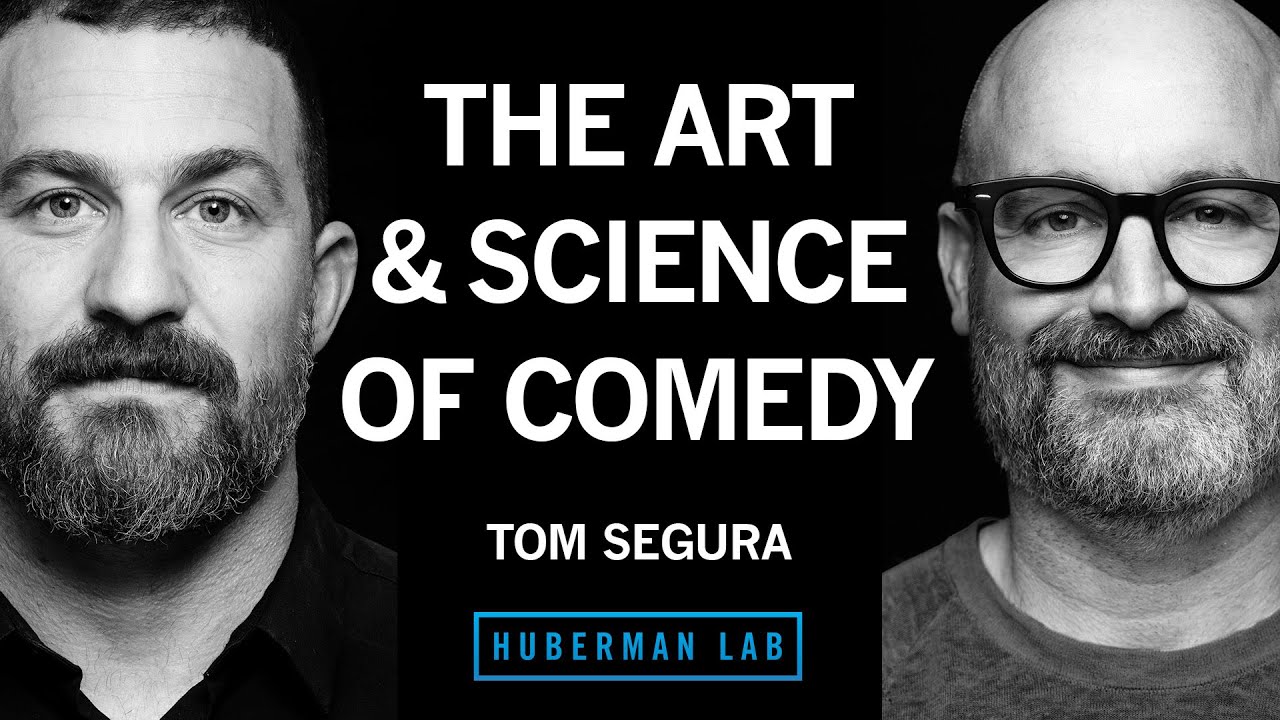
A common frustration with creativity is that you cannot force a great idea on demand, and you definitely cannot force something to be funny. In this Huberman Lab conversation, Tom Segura describes a practical, stage-tested way to build comedy from a “kernel” rather than a fully written script, while Andrew Huberman connects that process to attention, arousal, and reward circuitry. The episode also highlights why exercise can change mental clarity for hours, why phones can quietly pull attention even when unused, and how performers read and steer crowd emotion in real time. This article translates those ideas into brain-based, everyday tools.
Why you cannot “make it funny” on command
If you have ever sat down to be creative and felt your brain go blank, you have already met the central tension of this episode.
The discussion treats humor as something that often feels automatic, closer to taste or smell than to a logical argument. The implication is uncomfortable but freeing: you can refine delivery, structure, and timing, but you cannot fully negotiate what your nervous system flags as funny. In the conversation, this becomes a key lens for understanding both comedy and creativity more broadly. You can create conditions that make good ideas more likely, but you cannot force the final “click.”
This perspective also explains why certain feedback can be hard to use. When someone says, “That joke is not funny,” they may not be describing a moral stance or a conscious decision. They may be reporting a fast, body-level reaction. That does not mean you ignore feedback, it means you interpret it correctly.
There is a trade-off here.
If humor is partly automatic, then chasing universal approval becomes a losing game. But the flip side is that you can focus on finding the audience and the framing where your specific comedic instincts land best. In cognitive health terms, it is a shift from trying to control outcomes to controlling inputs.
Did you know? Even subtle distractions can reduce cognitive performance. In controlled research, simply having a smartphone nearby (even if you do not use it) can lower available attention, a phenomenon often described as “brain drain” in attention studies like those summarized in Nature and related journals (see discussion and links in the phone section below).
Segura’s “kernel first” approach to creativity
A distinctive feature of Tom Segura’s process is that he does not primarily start by writing a full script.
Instead, he emphasizes capturing a kernel of an idea, a small, promising seed, then taking it to the stage to see what happens. The stage is not just where the final product is delivered, it is where the product is built.
This is a very different approach from the “write it perfectly, then present it” model many people learn in school or at work. It is also a different relationship with uncertainty. The kernel is intentionally incomplete.
Why a kernel can beat a fully written draft
A kernel-first method has several cognitive advantages, and the episode highlights them indirectly through how Segura describes working:
The trade-off is obvious too.
Working in public, even in small clubs, can feel riskier than perfecting something in private. But Segura’s framing suggests that the risk is part of the mechanism. You are not only presenting, you are learning.
Pro Tip: If you want to borrow the kernel idea for everyday creativity, keep a capture tool that is frictionless for you. For some people it is voice memos, for others it is a notes app, a pocket notebook, or texting yourself. The best tool is the one you will actually use when you are tired.
From conversation to stage: how ideas get stress-tested
Another signature element in Segura’s description is that conversations are a primary writing room.
He points to everyday talk as a place where you naturally riff, notice what makes someone laugh, and detect which angles feel alive. Then the question becomes, “It is funny here, is it funny there?” Meaning, does it survive the shift from a private context to a performance context.
That framing matters for cognitive health because it highlights a basic truth about the brain: context changes cognition. A joke that works at dinner may fail under stage lights, not because the content changed, but because the audience’s expectations, attention, and emotional state changed.
A useful way to apply this outside comedy is to treat your first version of an idea as context-bound. A business idea that sounds brilliant in a casual chat may need a different structure in a boardroom. A vulnerable insight that feels clear in therapy may need different language in a relationship conversation.
Here are a few “stress-test” questions inspired by the episode’s logic:
The goal is not to overthink. It is to recognize that testing is part of building.
Exercise as a cognitive tool: arousal, fog, and focus
The episode opens in a surprisingly practical place: training, running, and how movement changes the mind.
Segura describes disliking running, but still doing it for a 5K, including a course with repeated ramps inside a stadium. Huberman contrasts that with his own enjoyment of running and a structured routine (long run, medium run, and a high-intensity session). The details are personal, but the cognitive theme is broader: exercise shifts mental state.
One of the most useful claims in this segment is that for long, steady exercise, a large portion of the cognitive benefit comes from increased alertness and arousal. In plain language, you feel more awake, more ready to focus, and less stuck in mental fog.
Segura describes a familiar experience: waking with a fog that can linger, then noticing that exercise “wipes it out.” That subjective report matches what many people notice, and it fits with established physiology. Exercise can increase catecholamines like epinephrine (adrenaline) and norepinephrine, which are strongly tied to alertness.
What the research shows: Regular physical activity is consistently associated with better cognitive outcomes across the lifespan. For example, the CDC’s physical activity guidanceTrusted Source summarizes evidence linking activity to improved brain health, including thinking and mood. The exact “best” dose varies by person, and medical conditions can change what is safe.
The trade-off: timing and intensity matter
A hard workout can make you feel ready for a demanding day, as Segura notes. But intensity and timing can also backfire for some people, especially if it disrupts sleep, worsens pain, or triggers overtraining.
If you are considering changing your routine and you have cardiovascular disease, uncontrolled high blood pressure, or you are returning after a long break, it is smart to check in with a clinician.
Important: Exercise can be a powerful mental-state tool, but sudden major changes in intensity can increase injury risk. If you have joint issues, a history of fainting, chest pain with exertion, or you are on medications that affect heart rate or blood pressure, get individualized medical guidance.
Running, “wordlessness,” and clearing mental clutter
A subtle but valuable idea in the transcript is the role of “wordlessness.”
Huberman describes long runs as a way to clear clutter, not necessarily because you get a lightning-bolt insight mid-run, but because you emerge with less noise. Segura describes trying to let his mind drift so he is not trapped in the misery of counting minutes.
This matters because many people think creativity is about adding more input. More podcasts, more articles, more prompts.
The episode pushes a different lever: subtracting input so the brain can reorganize. That reorganization is hard to measure in daily life, but it is consistent with what sleep and learning research suggests about consolidation and the brain’s need for downtime. For sleep specifically, the National Institute of Neurological Disorders and StrokeTrusted Source describes sleep as essential for brain function, including learning and memory. While running is not sleep, the analogy is that quiet states can support sorting and integration.
There is also a practical performance angle. Huberman notes that long, slow work can raise alertness in a way that makes deep work easier afterward. Segura echoes this with his observation that starting a busy day with a workout makes the whole day feel more manageable.
If you want to experiment with this without becoming a runner, the mechanism is not “running magic.” It is often movement plus reduced sensory load.
Try a brisk walk without headphones. Or cycle at an easy pace without a screen. Or do a simple resistance circuit and then sit down to work.
The phone-in-the-room problem: attention you do not notice
One of the most cognitively sharp moments in the episode is the claim that a phone can impair performance even when you are not using it.
The argument is that the brain is constantly simulating potential actions. If the phone is present, part of the brain is tracking the possibility of checking it, responding, or being interrupted. That background tracking consumes attention.
Huberman gives a specific example: students do worse on tests when their phone is in the room (even in a bag) compared with when it is in another room. That general finding aligns with published research on “brain drain,” including a widely cited set of experiments showing that the mere presence of a smartphone can reduce available cognitive capacity. A commonly referenced paper is Ward et al. in the Journal of the Association for Consumer Research, summarized in accessible form by outlets and discussed in academic contexts (you can start with the study page and references here: “Brain Drain” smartphone presence effectsTrusted Source).
The episode’s framing goes further, suggesting that even during sleep the brain tracks the environment more than we assume. While specific claims like doing math in REM sleep are intriguing, the broader point is conservative and useful: your brain remains responsive to cues, and reducing cues can improve rest and focus.
Here is the everyday trade-off.
Keeping your phone nearby can feel safer, convenient, and socially responsible. But it may come with a hidden tax on attention. Many people do not notice the tax because it feels normal.
Simple experiments to try
You are not trying to become a monk. You are testing how much your environment is shaping your brain.
Context-dependent brains: why environments cue behavior
A recurring theme in the conversation is that your brain is a “context machine.”
Huberman describes context-dependent behavior as a set of cue-triggered sequences, like a library that changes its shelves based on where you are and what you are about to do. When you step on stage, your brain pulls up a different set of expectations and action plans than when you walk into your kitchen.
This is not just a metaphor. In neuroscience, context and cues are central to how habits form and how behaviors get triggered. The basal ganglia and related circuits help link cues to routines, and dopamine signaling is often involved in reinforcing those links.
In practical terms, this can help explain:
A small example from the transcript is Huberman’s kettlebell carry in the hallway. The idea is to teach the nervous system to expect work immediately after waking, potentially shifting morning alertness. Whether or not you copy that exact routine, the cognitive principle is that anticipation is trainable.
»MORE: If you want a simple worksheet for cue design, create three columns on paper: “Cue,” “Routine,” “Reward.” Then map one habit you want to build (like writing daily) and one habit you want to reduce (like late-night scrolling). This is the same logic used in many behavior change frameworks.
Cannabis, stream of consciousness, and creative trade-offs
Segura describes using cannabis sometimes, especially at night, and noticing a specific effect: the mind starts running, ideas appear, and self-awareness can drop.
He characterizes the “right dosage” as one that is not so strong that it becomes uncomfortable or paranoid, but strong enough to loosen the usual mental shelving system. In his words, it can put uncomfortable or avoided thoughts in front of you, which can be creatively useful but also emotionally risky.
This is a nuanced, non-heroic description. It is not “cannabis unlocks genius.” It is “cannabis changes what shows up in consciousness,” and that can cut both ways.
From a cognitive health perspective, the trade-offs are worth stating plainly:
Research on cannabis and cognition is complex and depends on dose, THC to CBD ratio, frequency, age of first use, and individual vulnerability. For an evidence-based overview of cannabis health effects, including cognitive and mental health considerations, the National Institute on Drug Abuse cannabis resourceTrusted Source is a solid starting point.
If you are considering cannabis for any reason and you have a personal or family history of psychosis, bipolar disorder, or severe anxiety, it is especially important to talk with a qualified clinician. Vulnerability differs widely.
Capturing ideas without romanticizing the state
A practical detail in the transcript is the use of voice memos, sometimes recorded while high, then reviewed later. Segura notes that sometimes they are terrible, sometimes they contain something worth keeping, and you can even hear emotion in your own voice.
That last point is cognitively interesting: memory is not just content, it is state. When you listen back, you re-encounter the emotional tone that produced the idea.
If you want the benefit without relying on substances, you can mimic part of the mechanism by changing state in other ways, like a hot shower, a walk, or a short bout of exercise, then doing a quick “stream of consciousness” capture for three minutes.
Crowd energy and emotional contagion in performance
The episode highlights a performance skill that is also a social neuroscience skill: reading and shaping group emotion.
In the introduction, Huberman points to “emotional contagion” and how skilled performers become masters at dancing with the collective energy of crowds, from small clubs to arenas. This is not mystical. It is about perception, timing, and feedback.
A crowd is a living signal.
People laugh more when others laugh. They tense when others tense. They become quiet together. The performer senses micro-shifts, pacing changes, attention dips, and then adjusts.
In cognitive terms, this is a real-time loop between:
This is relevant even if you never touch a microphone.
Meetings, classrooms, family gatherings, and difficult conversations all involve emotional contagion. If you are trying to communicate clearly, it helps to notice the room’s arousal level and adjust your delivery. Sometimes the best move is to slow down. Sometimes it is to ask a question. Sometimes it is to stop talking and let the room reset.
Expert Q&A
Q: Why do some people seem to “feel the room” better than others?
A: Social sensitivity is partly skill and partly temperament. Many people improve with practice because they learn which cues matter, such as pace of responses, eye contact, and how quickly attention drops when a topic is confusing.
People also differ in baseline arousal and anxiety, which can distort perception. If you are highly anxious, you may read neutral cues as negative, and if you are under-aroused, you may miss subtle shifts.
Health writer review, informed by social neuroscience concepts and the episode’s discussion of emotional contagion
A practical, brain-informed creativity routine (without forcing it)
The episode’s unique perspective is not “here is a perfect creativity system.” It is closer to: build conditions, capture kernels, test in reality, and respect the brain’s automatic reactions.
Below is a routine that stays faithful to that logic while translating it into everyday life.
How to build a “kernel pipeline” in 5 steps
Create a low-friction capture habit. Keep one place for kernels (notes app, voice memos, or a pocket notebook). The goal is speed, not beauty. If you wait to write it “properly,” you will lose it.
Schedule one weekly stress-test. For comedians it is a club set. For you it might be sharing a concept in a meeting, posting a draft, pitching a headline, or telling a story at dinner. The point is to move from private certainty to public data.
Use movement to shift state before deep work. If you relate to the “morning fog,” experiment with 10 to 20 minutes of exercise before your hardest cognitive block. The CDC activity recommendationsTrusted Source can help you choose a safe baseline, and you can scale intensity to your body.
Reduce cue load during creation. Put the phone in another room for a set window. If you cannot, at least silence notifications and place it out of sight. This aligns with research on smartphone presence and attention capacity, including Ward et al. brain drain findingsTrusted Source.
Refine based on real reactions, not imagined ones. Segura’s approach is iterative. If something does not land, you do not necessarily throw it away. You adjust setup, reorder beats, or change the angle. In non-comedy work, this is editing, user testing, and feedback integration.
A key trade-off is emotional tolerance.
Iterative testing means you will collect “failures” quickly. That can sting. But it also prevents you from spending months polishing something that never had lift.
Quick Tip: After any stress-test, write a two-sentence debrief: “What got energy?” and “What lost energy?” Do it immediately. Your memory will rewrite the event within hours.
Expert Q&A
Q: Is it better to brainstorm alone or with other people?
A: The episode’s logic suggests both, but in different roles. Alone time can help you notice subtle observations and capture kernels without social pressure. Conversation can help you naturally riff, discover what is contagious, and reveal which ideas survive context shifts.
If you tend to overthink alone, add more social brainstorming. If you tend to perform and lose your own signal in groups, protect some solo capture time.
Health writer review, based on cognitive and behavioral principles discussed in the episode
Key Takeaways
Frequently Asked Questions
- Why does exercise sometimes make my brain feel clearer for hours?
- The episode highlights arousal as a major mechanism, exercise can increase alertness-related chemicals like adrenaline and norepinephrine, which may support focus afterward. If you have a medical condition that affects heart rate or blood pressure, ask a clinician what intensity is appropriate.
- Is it true that having my phone nearby can hurt concentration even if I do not check it?
- Research suggests yes, the mere presence of a smartphone can reduce available cognitive capacity in some settings. One practical test is to do a focused work sprint with your phone in another room and compare how you feel and what you produce.
- What does “kernel first” mean in a creative process?
- It means capturing a small seed of an idea quickly, then developing it through real-world use and feedback rather than writing a full, polished version first. This can lower friction and create faster learning loops.
- Does cannabis help creativity?
- Segura describes that cannabis can loosen self-awareness and increase stream-of-consciousness thoughts for him, which can generate ideas but can also trigger paranoia or discomfort at higher doses. Because effects vary widely and can affect sleep and mental health, it is best discussed with a qualified clinician if you are considering use.
- How can I apply comedy-style iteration if I am not a performer?
- Treat your first draft as a test, share it in a low-stakes setting, then refine based on real reactions and outcomes. You can also reduce distractions and use short exercise sessions to shift into a more alert state before doing deep work.
Get Evidence-Based Health Tips
Join readers getting weekly insights on health, nutrition, and wellness. No spam, ever.
No spam. Unsubscribe anytime.