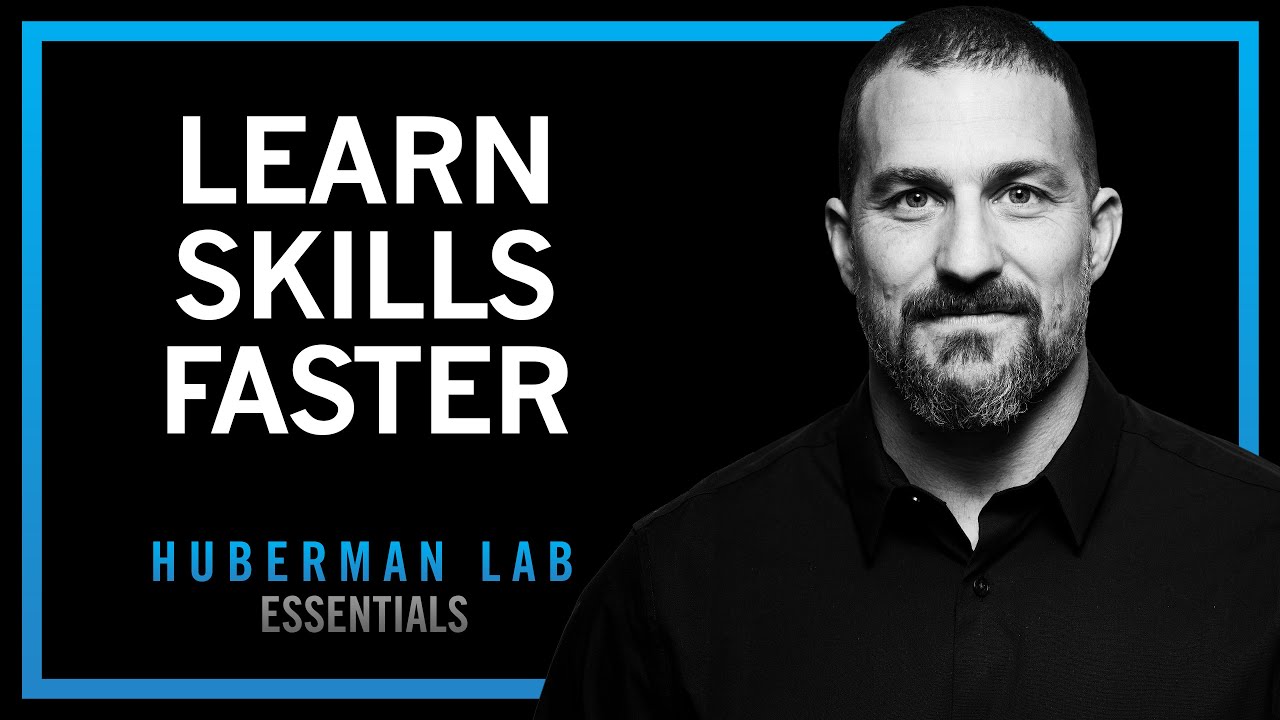
Learn Skills Faster: Reps, Errors, and Recovery
Summary
Want to learn a sport, instrument, or movement pattern faster without “hack” hype? This Huberman Lab Essentials perspective centers on one lever above all: increasing repetitions per unit time, including imperfect reps. Errors are not just allowed, they are a neurobiological signal that opens a window for plasticity, then short post-practice “idle time” helps the brain replay correct sequences and discard incorrect ones. As skill improves, attention can shift toward specific movement features, and tools like metronomes and limited visualization can amplify practice quality. Sleep remains a major consolidation partner.
How do some people learn a golf swing, dance sequence, or new lift pattern in weeks, while others grind for months and feel stuck?
This Huberman Lab Essentials framing is refreshingly unromantic: rapid skill learning is not a magic pill, and it is not best predicted by a mythical number of hours. The practical center of gravity is repetitions per unit time, paired with a willingness to generate errors safely, then giving the brain a short chance to “replay” what it just did.
That perspective matters for wellbeing, too. Skill learning is not only about performance, it is also a way to keep the nervous system adaptable. Neuroplasticity (the nervous system’s ability to change with experience) supports function across the lifespan, and movement learning can be a particularly potent driver.
Why do some people learn skills so much faster?
A lot of popular advice treats skill as either talent or time served.
This discussion pushes back on both extremes. Instant skill acquisition belongs in movies, and the “10,000 hours” idea is criticized as missing the most actionable variable. What drives progress is not just time, it is how many attempts you make while your attention is engaged.
A key nuance is that “attempts” include imperfect attempts. The nervous system does not only learn from smooth success, it learns from the mismatch between what you meant to do and what happened.
Did you know? The brain can continue processing a motor sequence immediately after practice, even when you stop moving. In sleep research, memory consolidation is strongly linked to sleep-dependent processing, including for motor skills, as summarized by the National Institute of Neurological Disorders and StrokeTrusted Source.
This is one reason the “how” of practice can matter as much as the “how long.”
Open-loop vs closed-loop skills: pick the right feedback strategy
Before you try to optimize learning, this approach recommends sorting your skill into one of two buckets.
Open-loop skills are discrete actions where you act, then you get feedback. Throwing darts is the example used: you throw, then you see where it landed.
Closed-loop skills are continuous, with feedback and adjustment happening moment to moment. Running stride work is the example: you can feel or be coached in real time and adjust posture, cadence, or foot placement as you go.
This classification is not academic nitpicking. It shapes what kind of feedback you should expect and how you should structure repetitions.
The three ingredients inside most motor skills
The skill-learning breakdown here emphasizes three components:
If you are learning a tennis serve, for example, you are not only learning “arm swing.” You are learning how the toss looks, how shoulder position feels, how timing unfolds, and how the outcome maps back to body position.
The practical question becomes: what should you focus on first, the outcome, the sound, the visual target, or the internal feel of your limbs?
The real engine of rapid learning: repetitions per unit time
The headline rule is simple: in early learning, aim for maximum repetitions per unit time, within safety.
Not maximum perfection.
Not maximum intensity at all costs.
Maximum density of attempts.
To support that claim, the discussion highlights a large online experiment often nicknamed the Super Mario effect. About 50,000 people learned a simple programming-like task: arranging commands so a cursor could navigate a maze. Two groups received different error feedback.
The result was counterintuitive. The “try again” group had a higher success rate (68%) than the “lost points” group (52%). The mechanism was not that they were smarter. They simply tried more times per unit time, and they persisted longer.
The framing here is important for health behavior change. If your practice environment makes errors feel like punishment, you may reduce attempts, and you may cut off the very repetitions that drive learning.
What the research shows: Motivation and reward signals are closely tied to dopamine, a neuromodulator involved in reinforcement learning. Dopamine’s role in learning and motivation is widely described in neuroscience resources such as the National Institute on Drug Abuse overview of dopamineTrusted Source (see sections discussing reward circuitry).
This does not mean you need to “feel happy” to learn. It means the brain’s learning machinery is sensitive to how outcomes are framed and whether you keep generating attempts.
Why errors matter, they open the plasticity window
Errors are not just information.
In this view, errors are a biological trigger.
When you make a mistake, the nervous system gets a signal that something needs to change. That recruits what is described as top-down networks in frontal cortex and engages neuromodulators associated with plasticity, including dopamine, acetylcholine, and epinephrine.
A key point is that walking away right when you are making errors can be the wrong move for learning. If you stop at the moment the system is most alerted to change, you may lose a prime opportunity to update the motor pattern.
There is also an animal research story used to make the point vivid: the tube test. Two rodents are placed in a tube, they push, and eventually one forces the other out. Winners tend to win again. When researchers stimulated a specific subregion of prefrontal cortex, animals became more likely to win regardless of prior status.
The emphasized behavioral output was not “more willpower.” It was more forward steps, meaning more attempts.
In practice terms, the learning-friendly mindset is not “avoid errors,” it is “make many safe attempts, notice the error, adjust, attempt again.”
Important: “More repetitions” should never mean reckless repetitions. If a movement has a meaningful injury risk (heavy lifting, sprinting, complex jumps), consider coaching, scaling the task, or reducing load so you can repeat it safely.
The overlooked step: post-practice idle time and replay
Most people end practice and immediately fill the next minutes with noise, notifications, conversation, or another task.
This approach argues that is a missed opportunity.
The claim is that immediately after a learning session, if you do nothing, even for 1 minute and ideally 5 to 10 minutes, the brain begins to “replay” the motor sequence. The replay is described as favoring correct sequences and eliminating incorrect ones, supporting faster consolidation.
This is not presented as mystical visualization. It is closer to giving the nervous system a quiet window to process what just happened.
A practical way to test it is simple: after practice, sit or lie down, close your eyes, and do not engage with your phone. Do not start a new learning task. Do not review video. Let your mind idle.
This idea aligns with broader sleep and memory science showing that consolidation continues after training and is strongly supported by sleep. Motor learning and sleep-dependent consolidation are commonly discussed in reviews of sleep function, including by the NINDS sleep overviewTrusted Source.
Pro Tip: If you only have time for a short session, do 10 minutes of highly focused practice aimed at high repetition density, then add 5 minutes of eyes-closed idle time. Treat that 5 minutes as part of training, not a bonus.
How attention should change as you get better
Early practice is messy by design in this framework.
You make lots of attempts, you make lots of errors, and you let errors guide what your attention should lock onto.
As you become more consistent, attention can become more deliberate. The discussion highlights a shift: once you are no longer dominated by errors, you can start focusing less on outcome and more on the movement itself.
For example, in a dart throw, instead of only rewarding “bullseye or not,” you might focus attention on the arm action, the wrist angle, or the smoothness of the release. This is described as embedding plasticity more deeply into the motor pattern.
This is also where “chunking” becomes more useful. Once the overall movement is somewhat stable, you can isolate subcomponents and refine them.
Edge case: when outcome focus can still matter
Outcome focus is not always wrong. In open-loop skills, outcome feedback is part of the task. The nuance is sequencing.
Early on, outcome can tell you you missed. But later, if you only chase outcome, you may stop improving mechanics. The suggested progression is outcome and errors first, then movement mechanics focus as proficiency rises.
When slow-motion practice helps, and when it backfires
Slow practice is often treated as universally good: “go slow to go fast.”
Here, the claim is more specific. Ultra slow movements may help after you already have some proficiency, not at the very beginning.
Two reasons are given:
A practical threshold is offered: consider introducing very slow movement work once you reach about 20 to 30% success. If you are still at 5 to 10% correct, ultra slow practice may not help much.
This is also task-dependent. You cannot throw a dart in ultra slow motion without the dart dropping.
If you want to apply this safely, you might use slow-motion work for components that can be slowed without changing the physics too much, such as foot placement drills, balance transitions, or parts of a lifting pattern with very light load.
Metronomes, external cues, and the power of cadence
Once you are intermediate or advanced, the discussion points to a surprisingly simple tool: a metronome.
The idea is not musicality. It is attention and repetition density.
By anchoring your movement to an external cadence, you create an outside “pressure” that can force more attempts per unit time. That often increases both successes and errors, and the errors keep plasticity engaged.
What is especially interesting in this perspective is the claim that even if you matched repetitions without a metronome, the external cadence may still accelerate learning for reasons that are not fully understood.
A vivid example is competitive cup stacking, where auditory cueing can push speed and consistency. You do not need to care about cup stacking to appreciate the principle: external rhythm can entrain attention and action.
Here are practical ways to use cadence without making practice chaotic:
»MORE: If you want a simple worksheet, create a “Reps Density Log.” Write the skill, the time block (10 minutes), total reps, and a rough success rate. Over weeks, the trend is often more informative than any single session.
Visualization: useful, but not equal to doing the reps
Mental rehearsal is not dismissed here.
It is placed in its lane.
Visualization, typically eyes closed and rehearsing the movement sequence, can activate upper motor neurons, which are involved in generating movement commands. That means mental practice can support the planning side of action.
But it is not equivalent to physical practice, and the argument is blunt about that. Actual movement generates proprioceptive feedback, engages lower motor neurons and pattern generators, and creates a different internal chemical and sensory environment.
So how might you use visualization without over-crediting it?
If visualization makes you feel more confident, that can be valuable. Just do not let it replace the physical repetitions that drive the sensory error correction loop.
Supplements and stimulants: what this approach does (and does not) claim
Many people want a pill for faster learning.
This perspective argues that no pill replaces repetitions. The more realistic question is whether something can support the foundation that allows more high-quality attempts, such as alertness, focus, or power output.
Only one supplement is highlighted in the transcript: Alpha GPC (alpha-glycerylphosphorylcholine), described as available over the counter in the United States.
Specific details given:
This is not presented as a universal recommendation. It is presented as something that might support performance in contexts where power output is a limiting factor, which could indirectly support skill learning by enabling more effective reps.
Caffeine is discussed similarly: it may help if it increases motivation and focus enough to do the work, but it can backfire if it disrupts sleep.
The sleep point is not trivial. If a late-day stimulant helps one session but reduces sleep quality, the net effect on learning could be negative. Sleep is a major consolidation tool, and sleep loss is associated with worse learning, attention, and reaction time in many studies, summarized broadly by institutions like the CDC sleep resourcesTrusted Source.
Timing nuance: cognitive vs motor learning
A specific timing distinction is mentioned from prior discussion: for cognitive learning, it can make sense to spike epinephrine after learning. For physical skill learning, stimulants like caffeine are framed as more useful before training, not after.
If you are considering supplements or stimulants, it is reasonable to discuss it with a clinician, especially if you have high blood pressure, anxiety, heart rhythm concerns, are pregnant, or take medications that interact with stimulants.
Expert Q&A
Q: If errors are “good,” should I practice to failure every time?
A: Not necessarily. The goal is a learning-relevant error signal while keeping movement quality and safety intact. For high-risk skills or heavy loads, you might scale difficulty so errors are small and correctable rather than dangerous.
A practical target is a session where you are challenged enough to miss sometimes, but not so overwhelmed that every rep is random. If pain, sharp joint discomfort, or form breakdown shows up, that is a reason to slow down, reduce load, or seek coaching.
Jordan Ellis, MS, CSCS (Strength and Conditioning Specialist)
Expert Q&A
Q: What should I do in the 5 to 10 minutes after practice if my schedule is tight?
A: The simplest version is sitting in your car, on a bench, or on the floor with your eyes closed and no phone. You are not trying to “think hard,” you are trying to avoid new inputs so the nervous system can replay what you just practiced.
If you must transition immediately, try to at least avoid a second learning task (for example, do not jump from tennis practice into intense language study). Protecting even 60 seconds of quiet can be a meaningful start.
Mina Patel, MD (Physical Medicine and Rehabilitation)
Key Takeaways
Frequently Asked Questions
- Is it better to practice longer or practice with more repetitions per minute?
- This video’s central emphasis is repetition density, meaning more attempts per unit time, especially early in learning. Longer practice can help, but only if attention stays high and you can keep generating safe, meaningful reps.
- How long should I rest after a skill practice session?
- A short period of doing nothing right after practice is highlighted, even 1 minute, and ideally about 5 to 10 minutes. Sitting quietly with eyes closed and avoiding your phone may support replay and consolidation.
- Should I use slow-motion practice when I am a beginner?
- Not always. The perspective here is that ultra slow practice may be more useful after some proficiency is established, roughly when you can succeed about 20 to 30% of the time, because early learning benefits from errors and realistic proprioceptive feedback.
- Does visualization work for learning skills faster?
- Visualization may help as a supplement because it activates movement-planning circuits, but it is not considered a replacement for physical practice. Real movement provides proprioceptive feedback that mental rehearsal cannot fully replicate.
- What is Alpha GPC and what dose is mentioned?
- Alpha GPC (alpha-glycerylphosphorylcholine) is discussed as an over-the-counter supplement in the U.S. The transcript mentions common doses of about 300 to 600 mg and notes it has been studied for effects on power output in some contexts.
Get Evidence-Based Health Tips
Join readers getting weekly insights on health, nutrition, and wellness. No spam, ever.
No spam. Unsubscribe anytime.