Blueprint Longevity: Sleep, Data, and “Don’t Die”

Summary
Most longevity advice fails because it is built on vibes, not verification. In this conversation with Prof. Tim Spector, Bryan Johnson describes Project Blueprint, a high-measurement, high-discipline attempt to slow biological aging by stacking evidence-based habits and tracking outcomes across dozens of markers. The video’s unique lens is not “one magic supplement”, it is an operating system: measure everything, prioritize sleep as the top lever, and use biological age tools like DNA methylation clocks to test whether changes help or harm. You will also hear about unconventional markers, like sleep fragmentation and even nighttime sexual arousal, framed as signals of overall physiology.
What most people get wrong about longevity
Most people treat longevity like a scavenger hunt for hacks.
They collect supplements, cold plunges, gadgets, and “one weird trick” routines, then assume the stack automatically adds up to a longer, healthier life. The unique perspective in this video pushes back hard on that culture. The argument is that longevity is not primarily about collecting interventions, it is about building a system that can tell you whether an intervention is helping, harming, or doing nothing.
That system is measurement.
A second mistake is assuming aging is fixed. The conversation repeatedly returns to the idea that life choices can meaningfully change the speed at which someone ages, and that some markers in midlife can look better than the average teenager’s, at least on paper, if you choose the right targets and execute consistently.
There is also a quieter mistake hiding underneath the hype: focusing on dramatic, rare interventions while ignoring the basics that reliably move multiple health systems at once. In this framing, sleep is the prime example. It is not glamorous, but it is presented as the strongest lever for slowing the “speed of aging.”
Important: If you are considering major lifestyle changes, intensive testing, or any medical procedure, it is wise to discuss plans with a licensed clinician who knows your history, medications, and risk factors.
Project Blueprint in one sentence: measure, rank, iterate
Project Blueprint is described as a scientific attempt to answer an enormous question: could humans be the first generation to meaningfully escape the historical inevitability of death, or at least push healthy lifespan to an “unknown horizon?” That is the philosophical framing. The practical framing is more concrete: hire a large medical team, review the literature, stack-rank interventions by evidence, and then implement and measure.
The approach is intentionally anti-storytelling.
Instead of “I feel great,” the project tries to quantify outcomes across dozens of domains. The discussion highlights blood markers (like lipids and inflammatory markers), imaging (MRI-based brain measures), performance (like VO2 max), sleep staging, and biological age tools such as DNA methylation patterns.
One notable feature is the commitment to breadth. Many people focus on one system, like heart health or weight. Blueprint tries to track the whole organism, including organ-specific function and anatomy, and then ask a practical question: what does “peak” look like for each category, and can a 40s or 50s body approximate that peak?
A quick note on evidence quality
The video also includes a candid discussion about the messiness of evidence in longevity.
Prof. Tim Spector contrasts Blueprint’s “try everything that might work” posture with Zoe’s more conservative posture, which emphasizes interventions supported by randomized controlled trials. He also explains why animal studies can mislead: mice have short lifespans, different biology, and research bias can creep in when only positive experiments are published.
This matters because it sets expectations. Even a highly measured, well-funded project still has uncertainty, and translating results to other people is not straightforward.
Did you know? Many “anti-aging” claims start in cells or rodents. Those early findings can be useful for generating hypotheses, but they often fail to replicate in humans at meaningful scales. That is why the video keeps returning to measurement and skepticism.
Sleep is “number one”: why this approach puts it first
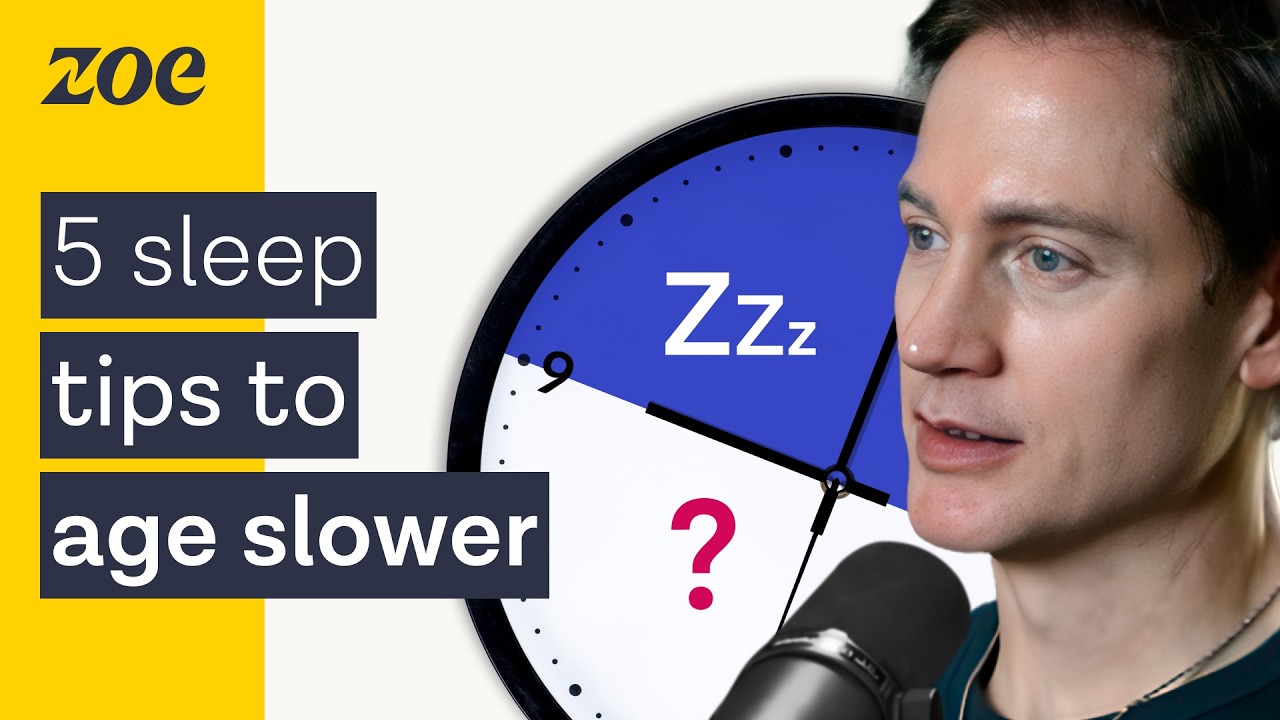
The most repeated, most actionable claim is blunt: after evaluating the scientific literature on what slows aging, sleep is number one.
In this framing, sleep is not a wellness accessory. It is a biological maintenance window that touches nearly every system Blueprint cares about measuring: immune signaling, glucose regulation, appetite hormones, cardiovascular stress, mood, training recovery, and cognitive performance.
The discussion also ties sleep directly to aging patterns. As people get older, sleep often becomes lighter and more fragmented, with longer sleep onset (it takes longer to fall asleep), more awakenings, and reduced deep and REM sleep. The argument is that these shifts are not merely annoying, they are measurable signals that correlate with worse health trajectories.
A key detail from the transcript is the emphasis on sleep scoring and consistency. Johnson claims an extraordinary period of “perfect sleep” over months, and he connects that to improvements in his measured pace of aging.
That does not mean everyone needs a lab, a team, or a perfect score.
It means most people will get more longevity return from improving sleep regularity and duration than from chasing exotic add-ons.
What the research shows: Adults generally need at least 7 hours of sleep per night for optimal health, and short sleep is associated with higher risk of adverse outcomes in large population studies. The American Academy of Sleep Medicine and Sleep Research Society recommend 7 or more hours for adults on a regular basis (sleep duration consensus statementTrusted Source).
Five sleep habits “everybody can do” (adapted to real life)
The transcript references “five habits for sleep that everybody can do,” but does not fully list them in the portion provided. Still, the video’s sleep-first philosophy translates well into practical, widely accepted levers that align with mainstream sleep science.
A simple self-check can be surprisingly informative: do you wake feeling restored most days, and do you stay alert without fighting sleep during the afternoon? If not, sleep may be the first place to iterate.
Pro Tip: If you track sleep, focus less on one night’s score and more on trends: bedtime consistency, total sleep time, and how often you wake up during the night.
What “speed of aging” means here, and why epigenetic clocks are central
Aging is a slippery word.
In this video, “speed of aging” is tied heavily to epigenetics, specifically DNA methylation clocks. Methylation patterns change with age and exposures, and clock algorithms attempt to translate those patterns into an estimate of biological age or aging pace.
The discussion emphasizes two related but different ideas:
A distinctive feature here is frequency. Johnson describes measuring epigenetic age weekly for years, then using those data to “titrate” which behaviors speed aging up or slow it down.
This is an unusually intense approach, and it highlights both promise and limitations.
Epigenetic clocks are exciting because they offer a plausible biological “dashboard,” potentially sensitive to lifestyle changes. But they are still evolving tools. Different clocks can disagree, and a lower score does not automatically mean a lower risk of every disease. If you use these tests, it helps to treat them as one signal among many, not a verdict.
Important: If you pursue direct-to-consumer biological age testing, consider how you will interpret results before you test. A single number can create anxiety or false reassurance, especially if you do not pair it with clinical context and basic risk screening.
The Rejuvenation Olympics: turning health from storytelling into data
A clever idea in the video is the creation of a public competition: the Rejuvenation Olympics, where people compare their “speed of aging” using methylation clocks.
The stated purpose is not just bragging rights. It is an attempt to change the culture of health optimization from narrative to measurement. In the video, this is framed as a response to the way people “flex” wellness behaviors like sauna, cold plunge, or testosterone levels while skipping hard outcomes.
There is also an implicit scientific goal: when many people share data and routines, patterns can emerge faster. Someone may beat another person’s score with fewer interventions, raising questions about genetics, baseline health, or which parts of a routine actually matter.
One anecdote in the transcript captures this tension. A top-ranked participant reportedly claimed to do “nothing” for his health, suggesting a strong genetic component or unknown confounders. That story is used to argue for openness: if methods and results are public, the community can learn.
This is crowdsourcing, but with biomarkers.
It is also a reminder: if you compare yourself to others, you need humility about genetics, measurement noise, and differences in testing methods.
»MORE: If you are interested in a safer version of “competition,” consider creating a personal dashboard instead: sleep consistency, waist circumference, blood pressure, fasting lipids, strength benchmarks, and a simple mood and energy log.
The diet philosophy: “nothing nice-to-have” versus real-world variety
Blueprint’s diet philosophy is described with unusual strictness: vegetables, legumes, berries, nuts, seeds, and nothing that is merely “nice to have” or included just because it tastes good.
That is a distinctive stance. It reframes food as inputs for measurable outcomes, not pleasure, tradition, or convenience.
Prof. Spector’s counterpoint is equally distinctive, and it is practical. He argues for some degree of self-experimentation, especially with food variety, and suggests a simple method: notice how you feel a few hours after eating something. That can reveal whether a food “agrees with you,” even before labs.
This creates a useful tension for readers.
On one end is an extreme elimination of non-essential foods. On the other is a flexible, curiosity-driven approach that tries to expand plant diversity and observe responses.
From a research standpoint, a plant-forward pattern is broadly consistent with evidence linking higher intake of minimally processed plant foods to better cardiometabolic outcomes. Diet patterns like the Mediterranean diet are associated with lower cardiovascular risk in trials, although they are not as restrictive as Blueprint’s framing (PREDIMED trial overviewTrusted Source).
A practical compromise for most people
If you are not trying to live like a full-time experiment, you can still borrow the video’s logic.
This keeps the spirit of Blueprint without requiring monastic rigidity.
The marker mindset: aiming for an 18-year-old peak across systems
A core concept in the conversation is “pegging” markers to peak levels.
Instead of comparing a 49-year-old to other 49-year-olds, the goal is to compare each system to its peak age. The transcript mentions examples:
The claim is that some functional markers can be pushed into ranges seen in late teens, even if anatomy remains older. This is a subtle but important distinction: you can improve risk and function without pretending you can literally become anatomically 18 again.
The video uses VO2 max as a flagship marker, describing results in the top percentiles of 18-year-olds.
From a mechanism perspective, this focus makes sense. Cardiorespiratory fitness is strongly associated with mortality risk in observational research, and improving fitness typically improves multiple intermediate markers, such as blood pressure, insulin sensitivity, and inflammatory signaling.
Did you know? Higher cardiorespiratory fitness is consistently associated with lower all-cause mortality risk in large cohort studies, even after adjusting for other factors. Fitness is not the only factor, but it is a powerful one (fitness and mortality reviewTrusted Source).
In Blueprint’s framing, this is why measuring matters. If your goal is “anti-aging,” you need to decide what you mean, then pick markers that plausibly map to disease risk and function.
An unexpected metric: nighttime sexual arousal as a health signal
The most surprising part of the transcript is the discussion of nighttime sexual arousal, described as “nighttime erections,” and framed as a marker of overall health.
It is introduced accidentally. The goal was to reduce nighttime bathroom trips, which disrupt sleep. A pelvic floor or muscle stimulation intervention was used to improve bladder control, and a side effect was increased nighttime erections. That prompted a literature search and the discovery that nocturnal sexual arousal correlates with vascular and autonomic function.
This is where the video’s “measure everything” ethos becomes obvious.
The conversation claims that an average 18-year-old male has around 2.5 hours of nocturnal erections per night, that duration declines with age, and that absence is associated with increased risk of premature death. It also notes that similar cycles occur in both males and females, and that the phenomenon is linked largely to REM sleep.
From a mainstream clinical perspective, nocturnal penile tumescence testing has historically been used in specific contexts to help distinguish psychogenic from organic contributors to erectile dysfunction. More broadly, erectile function is often considered a vascular health signal because penile blood flow is sensitive to endothelial function.
Research supports a relationship between erectile dysfunction and cardiovascular disease risk, although the exact numbers and causal pathways depend on population and definitions. For example, erectile dysfunction is associated with increased risk of cardiovascular events in multiple studies and meta-analyses (erectile dysfunction and CVD riskTrusted Source).
Still, it is crucial to keep the interpretation grounded. A single metric can be affected by sleep deprivation, medications, alcohol, mental health, hormonal status, and relationship context. If someone notices a major change, it is a reason to talk with a clinician, not a reason to panic or self-treat.
Q: Should I track nighttime sexual arousal to assess my health?
A: For most people, it is not necessary. The video uses it as an example of how unexpected physiological signals can correlate with broader systems like sleep quality and cardiovascular function.
If you notice persistent changes in sexual function, morning erections, or libido, it can be worth discussing with a healthcare professional because those changes sometimes overlap with sleep problems, medication effects, mood disorders, or cardiometabolic risk.
Health Writer Review, medically cautious interpretation
Self-experimentation without self-deception: how to test changes safely
“Life is an experiment every second of every day” is one of the most practical lines in the conversation.
But self-experimentation can go wrong when it becomes chaotic, expensive, or driven by confirmation bias. The video implicitly offers a better model: pick a small set of sturdy markers, change one thing at a time, and watch trends.
Here is a Blueprint-inspired, real-world way to do that, without needing 30 doctors.
How to run a simple, safer N-of-1 experiment
Choose one outcome you care about. Sleep continuity, blood pressure, resting heart rate, fasting glucose, training recovery, or GI symptoms are common choices. The best outcomes are measurable and meaningful.
Pick one change to test for 2 to 4 weeks. Examples include stopping caffeine after a certain time, adding a 20-minute morning walk, or shifting dinner earlier. Avoid stacking multiple changes at once, because you will not know what caused what.
Keep the rest stable. Your baseline diet, alcohol intake, exercise volume, and bedtime should be as consistent as possible. Stability is boring, but it is what makes the data interpretable.
Track both numbers and lived experience. The video emphasizes biomarkers, but Prof. Spector highlights subjective response. A simple daily note like “energy 1 to 10” or “bloating yes or no” can reveal patterns labs miss.
Review, then decide. If the change clearly helps, keep it. If it harms, stop. If it does nothing, you have learned something valuable and you can move on.
This is the antidote to influencer-style optimization.
Pro Tip: If you have a chronic condition, take prescription medications, or have a history of eating disorders or obsessive tracking, consider involving a clinician before adopting intensive measurement routines. More data is not always better for every brain.
The “Don’t Die” ideology, and how to translate it into daily life
The video goes beyond health tips and proposes an ideology: “Don’t Die” as a new operating system for humanity.
Whether or not you resonate with the philosophy, the practical implication is clear. If death and decline are treated as malleable, then daily decisions become higher leverage. Sleep is not optional. Exercise is not a hobby. Food is not just entertainment. Measurement is not vanity, it is feedback.
There is also a future-facing argument: rapid advances in AI could accelerate biomedical progress, potentially compressing decades of discovery into years. The framing is intentionally expansive, suggesting we should not artificially limit imagination about lifespan.
For readers, the useful part is not predicting the 25th century.
It is adopting the piece that works today: treat your health behaviors as a system, prioritize the highest-return levers, and measure enough to stay honest.
A realistic “Don’t Die” starter plan
This is a grounded translation of the video’s worldview into steps many people can attempt.
What the research shows: High blood pressure is a major, modifiable risk factor for heart disease and stroke, and even small reductions can improve population risk. Monitoring at home with a validated cuff is often recommended as a practical tool for many adults (American Heart Association on home BP monitoringTrusted Source).
Key Takeaways
Frequently Asked Questions
- Is sleep really more important than supplements for longevity?
- In the video’s framework, yes, sleep is described as the strongest, most universal lever for slowing the pace of aging. Supplements may help some people, but sleep affects many systems at once, including metabolism, immune signaling, and cardiovascular stress.
- What does “speed of aging” mean in this video?
- It refers mainly to biological aging estimates derived from DNA methylation patterns, often called epigenetic clocks. The idea is to track how quickly those markers change over time, then test whether lifestyle changes appear to slow that pace.
- Can a middle-aged person have health markers better than a teenager?
- The conversation suggests some functional and risk markers, like cardiovascular fitness percentiles or inflammatory markers, can sometimes be improved into ranges typical of younger people. Anatomy still ages, but measurable function and risk profiles may improve with sustained habits.
- Do I need extensive testing to apply these ideas?
- No. A practical version is to prioritize sleep, build fitness, eat a plant-forward diet, and track a small set of meaningful metrics like blood pressure, waist circumference, resting heart rate, and sleep consistency. If you add advanced testing, consider doing so with clinical guidance.
- Why does the video mention nighttime sexual arousal as a health metric?
- It is presented as an unexpected marker that can correlate with vascular function, autonomic health, and REM sleep quality. Persistent changes in sexual function can have many causes, so it is best discussed with a healthcare professional rather than interpreted in isolation.
Get Evidence-Based Health Tips
Join readers getting weekly insights on health, nutrition, and wellness. No spam, ever.
No spam. Unsubscribe anytime.