Inside Mass Casualty Triage: Airway, Chest, Blood
Summary
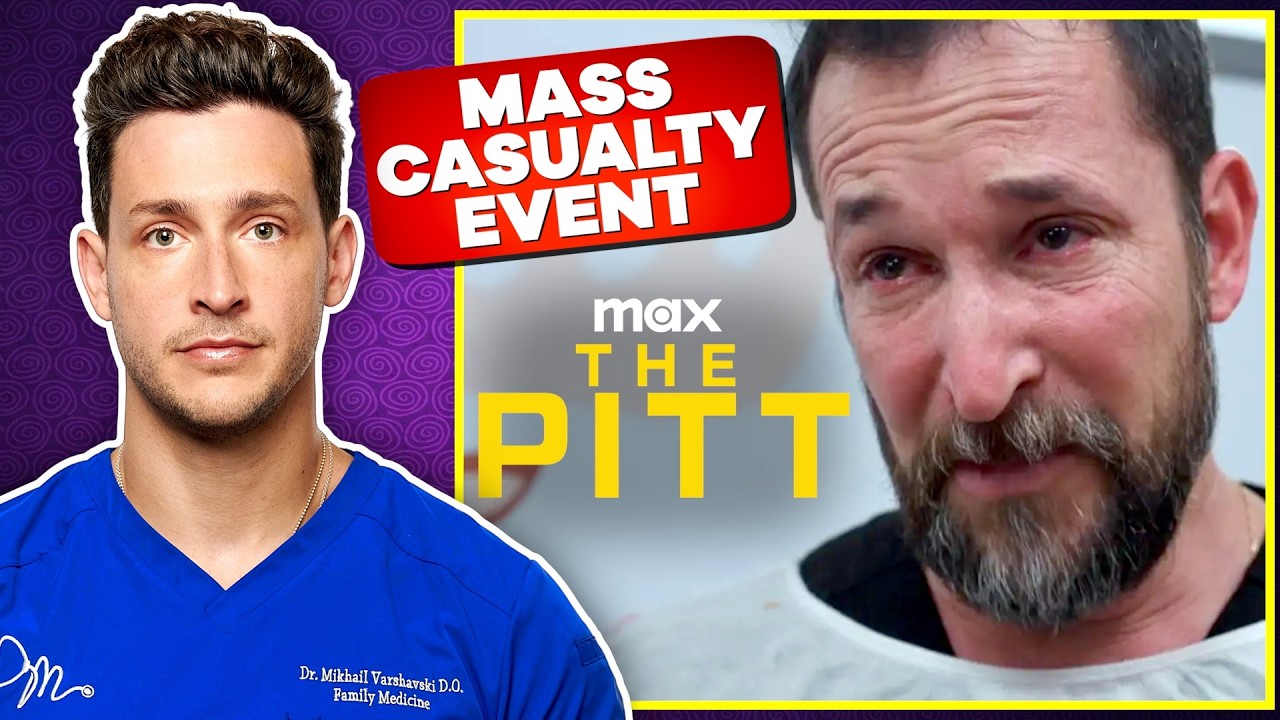
Mass casualty events turn an emergency department into a resource-allocation puzzle where seconds matter and perfect care is not always possible. In this video reaction to The Pitt (Episodes 12 and 13), a level-one trauma ER physician breaks down how hospitals surge staff and supplies, triage patients in seconds, prioritize airway and chest threats, and use fast tools like intraosseous access. The discussion also highlights less-obvious realities, communication outages, minimal charting, pediatric differences, and the emotional load of family reunification. This article unpacks those insights and connects them to science-backed trauma principles.
Mass casualty events are usually described as a test of “trauma care.”
But the deeper truth is simpler.
They are a test of breathing.
When a hospital is flooded with gunshot wounds, crush injuries, and panic-driven stampedes, the fastest deaths come from problems that stop oxygen from reaching the brain, airway obstruction, collapsed lungs, blood filling the chest, or shock so severe that breathing becomes ineffective. The video reaction to The Pitt episodes 12 and 13 leans into that reality, showing how an ER team shifts from routine medicine to what the clinician calls “no frills combat zone medicine,” where decisions are made in seconds, not minutes.
This article investigates that viewpoint, why it makes sense physiologically, and what it reveals about preparedness, respiratory emergencies, and overall wellbeing.
Why mass casualty triage is a respiratory story
Mass casualty triage can sound like paperwork and colored tags.
In practice, it is a blunt attempt to keep as many people alive as possible when oxygen delivery is threatened across dozens of bodies at once.
The discussion highlights a recurring priority order that shows up in trauma systems worldwide: airway first, then breathing, then circulation. Clinicians may use the shorthand ABC, but the “B” in that sequence is often where chaos concentrates. A chest wound that “looks okay” can turn into a life-threatening tension pneumothorax (air trapped in the chest that compresses the lung and heart). A patient who is talking can still be minutes away from respiratory collapse if blood is filling the chest cavity.
What is unique in this video is the insistence that triage is not about doing everything.
It is about doing the right few things, fast, and accepting that normal standards of documentation, monitoring, and imaging may not be available.
Did you know? Many EMS and hospital systems use structured triage methods such as START or SALT during mass casualty incidents. These frameworks are designed to prioritize immediate threats to breathing and circulation, not to create perfect diagnoses. You can learn more about disaster triage concepts through the U.S. Department of Health and Human Services ASPR guidanceTrusted Source.
From normal ER to surge mode, what changes in minutes
One of the most realistic moments in the reaction is not a procedure.
It is the huddle.
The video shows an activation where the hospital moves patients out of the emergency department, clears hallways, and turns trauma rooms into multi-patient bays. That is a core surge tactic: create physical capacity first, then staff it, then supply it.
In the clinician’s breakdown, “mobilizing resources” is not abstract. It is scanners, blood products, IV supplies, gauze, gloves, and even curtains being removed so teams can see more patients at once. The point is visibility and throughput. In routine care, privacy and one-patient-per-room are the default. In a mass casualty event, the default becomes situational awareness.
A particularly striking detail is the plan to place four gurneys in each trauma bay. That is not about comfort. It is about command and control. One attending and one team can stand in one location and manage multiple critical patients with rapid reassessments.
What “surge staff” really means
The video also acknowledges a limitation that the public often misses: you can “activate” extra staff, but you cannot magically create them.
Availability is the bottleneck.
Hospitals may call in off-duty clinicians, pull staff from inpatient units, and reassign people from elective areas. In disasters, this is commonly managed through an incident command structure. FEMA describes incident command as a standardized approach to coordination across agencies and facilities, which is outlined in the National Incident Management System (NIMS)Trusted Source.
That matters for respiratory care because ventilators, oxygen delivery systems, respiratory therapists, and airway-skilled clinicians are not infinite resources. When the surge exceeds those resources, triage becomes harsher.
Pro Tip: If you ever find yourself at a large public event during an emergency, use text messages instead of calls when possible. Texts often require less bandwidth and may go through when voice networks are congested.
When communication fails, the medical plan changes
The video makes a practical point that is rarely emphasized in TV medical drama: cell service can go down.
It is not a plot device.
When thousands of people call at once, local networks can overload. The reaction compares it to Black Friday crowds or earthquakes, moments when everyone tries to contact loved ones simultaneously.
This has direct clinical consequences. If EMS cannot communicate how many patients are coming, and if police radios are overloaded, the hospital cannot match staffing to need. It also affects families. The advice to “call your loved ones now” is less about reassurance and more about reducing later chaos.
There is also an internal communication problem. Wi-Fi can fail, electronic medical records can become unusable, and even basic patient tracking can break down. The show’s solution is stark: no board, no EMR, minimal charting, Sharpies, and paper.
This is not just operational.
It changes patient safety.
The video raises a fear many clinicians share: what are the legal and ethical implications when charting is incomplete? While laws vary, crisis standards of care are a recognized concept in disaster medicine, and many jurisdictions plan for altered documentation and triage processes during declared emergencies. A detailed overview of crisis standards is available through the National Academies of SciencesTrusted Source.
The triage tags and slap bands, the ethics behind the colors
The reaction spends meaningful time on the color tag system, and the explanation is unusually clear.
It is also emotionally difficult.
Here is the framework described:
The show adds an extra layer, a pink zone for patients who “will die in under an hour without treatment.” That nuance is important because it acknowledges that “red” is not one category. Some people need help now, others need help right now.
This color logic is not about worth.
It is about math.
The clinician underscores a hard truth: in routine care, a pulseless patient might get a full resuscitation attempt. In a mass casualty event, using a full team and supplies on a patient with very low survival odds can cost multiple other lives.
Important: If you ever witness triage in a disaster and it seems “cold,” remember that triage is designed to maximize total survivors. It is not a statement about who matters.
Ten-second triage, AVPU, and why monitoring gets skipped
“The goal is to triage each patient in 10 seconds.”
That line captures the entire philosophy.
The video describes a stripped-down approach: assess mental status and pulse strength, do not rely on labs, CT, X-ray, or even ultrasound in many cases. Mental status is assessed using AVPU, alert, responds to verbal, responds to pain, unresponsive.
In day-to-day medicine, clinicians gather data.
In mass casualty medicine, clinicians gather signals.
A strong pulse suggests perfusion. A patient speaking suggests airway patency and at least some ventilation. A patient with altered mental status may be hypoxic, hypotensive, bleeding internally, or suffering head injury.
The reaction also answers a question many viewers would have: do you hook everyone up to telemetry monitors?
Usually, no.
Monitoring costs time, equipment, and staff attention. In an overwhelmed environment, the team may prioritize quick reassessments in an open area over individual monitors. This is a classic tradeoff between individualized precision and population-level survival.
What the research shows: Disaster triage systems prioritize rapid categorization and reassessment over detailed diagnostics. The goal is to allocate limited resources efficiently. Overviews of triage approaches are discussed in disaster medicine resources such as the CDC emergency preparedness materialsTrusted Source.
Airway decisions under pressure, intubation, LMAs, and oxygen reality
Airway management is one of the most technically demanding parts of emergency medicine.
It is also one of the most time-sensitive.
The reaction highlights a pragmatic approach: in critical patients, place an IO, secure an airway, give blood, and place a chest tube if needed. The clinician notes they can place a supraglottic airway such as an LMA (laryngeal mask airway) and an IO in about 10 seconds.
That detail is revealing.
It signals a shift from “best airway” to “fast airway.”
In routine care, intubation with an endotracheal tube is often the gold standard for airway protection and ventilation. In mass casualty conditions, a supraglottic airway may be a rapid bridge, especially when the patient’s airway is at risk but time and staffing are limited.
Oxygen is a resource too
The video does not explicitly dwell on oxygen supply, but the logic points there. When many patients arrive with chest trauma, smoke exposure, panic hyperventilation, or shock, oxygen delivery systems can become strained.
Hospitals typically rely on piped oxygen, cylinders, and devices like nasal cannulas, nonrebreather masks, and ventilators. In large surges, even basics like tubing and masks can run short.
For readers interested in how oxygen targets vary by condition, the World Health Organization guidance on oxygen therapyTrusted Source provides a high-level overview, including the importance of oxygen systems in emergency care.
Chest trauma priorities, pneumothorax, chest tubes, and the 1,500 mL rule
The respiratory system becomes brutally concrete when the chest is injured.
Air and blood compete with the lungs for space.
The reaction repeatedly returns to chest interventions: carrying an 11-blade scalpel for decompression, placing chest tubes, and recognizing when chest bleeding is beyond what a tube can solve.
One threshold is stated clearly: if a chest tube returns more than 1,500 milliliters of blood immediately, that is a sign the patient needs urgent operative management.
That number is not random.
In trauma care, massive hemothorax is often defined using similar thresholds, and immediate large-volume output from a chest tube is a classic indicator of ongoing intrathoracic bleeding that may require surgery. Trauma education resources, including ATLS-based summaries, often reference these decision points. For a public-facing overview of chest trauma and pneumothorax concepts, see the Merck Manual pneumothorax pageTrusted Source.
The clinician in the video also emphasizes why a scalpel matters: if a patient develops a tension pneumothorax, you may need to rapidly open the chest wall and decompress to let trapped air escape.
This is not a home procedure.
But it explains why trauma teams think in terms of immediate mechanical fixes.
Two chest tubes, two sides, one principle
A brief exchange in the reaction notes a patient with wounds on both sides who “is going to need two chest tubes.” The principle is that each side of the chest is its own pleural space. A pneumothorax or hemothorax can occur on one side or both.
In mass casualty conditions, this becomes a workflow problem.
Every chest tube consumes time, sterile supplies, and staff, and each tube can be the difference between survival and death for that patient.
Resource callout: Want a plain-language primer on pneumothorax basics and symptoms? The NHLBI overview of pneumothoraxTrusted Source is a helpful starting point.
Bleeding control and circulation, IO access, blood, and hemostatic gauze
Breathing is not only about lungs.
It is also about blood.
Oxygen must be carried to tissues, and hemorrhage breaks that system quickly. The reaction highlights three practical tools: IO access, rapid blood administration, and hemostatic gauze.
Why IO access shows up everywhere in the episode
An intraosseous (IO) line is essentially vascular access through the bone marrow. The clinician describes drilling through skin into bone, then using that route to deliver medications, fluids, pressors, and blood, and even to obtain labs.
The key insight is speed.
In severe blood loss, veins can collapse and peripheral IV placement can become slow or impossible. IO access bypasses that problem.
A procedural nuance is also mentioned: puncture the skin first before drilling, because the skin can twist. That is the kind of practical, hands-on correction that comes from real procedural experience rather than textbook summaries.
For readers who want more background, the Cleveland Clinic overview of intraosseous infusionTrusted Source explains when IO is used and what it involves.
“Fill the tank back up,” blood as a time-critical medication
When the show depicts staff “squeezing” blood products into a patient, the reaction explains why: squeezing increases flow compared to gravity.
Then comes the operational critique: squeezing uses hands.
In a mass casualty event, hands are the scarcest resource. The clinician notes that pressure bags or even makeshift blood pressure cuffs can speed transfusion without tying up a person.
This is a recurring theme.
The best technique is often the one that frees a clinician to treat the next patient.
Hemostatic gauze, pressure dressings, and tourniquets
A wound that is “bleeding pretty briskly” gets treated with hemostatic gauze and then a pressure dressing. The reaction explains hemostatic gauze as gauze impregnated with clot-promoting factors.
But there is an important boundary: if bleeding is arterial, packing alone may not be enough.
The discussion stresses that arterial bleeding can be catastrophic, even within seconds, and that a commercial tourniquet is preferred over improvised cloth.
Public health agencies emphasize that rapid bleeding control saves lives, and civilian training programs like Stop the Bleed focus on tourniquet use and wound packing. You can find an overview through the American College of Surgeons Stop the Bleed programTrusted Source.
Standalone statistic: Uncontrolled severe bleeding can lead to death in minutes, which is why modern trauma systems treat hemorrhage control as urgent as airway management.
The full-body exam, why undressing matters more than you think
One of the most vivid points in the reaction is also the simplest: you can miss a gunshot wound if you do not look.
Adrenaline lies.
The clinician describes patients who insist they were not shot, then are found to have gunshot wounds in the legs after clothing is removed. This is not just denial. It can be shock, distraction, noise, and the body’s stress response blunting pain.
A full-body exam in trauma is meant to identify entry and exit wounds, hidden bleeding, and injuries that do not match the story. In a mass casualty event, the temptation is to skip steps.
The video argues you cannot.
At minimum, the exam needs to be fast, systematic, and repeated.
This is also where respiratory risk hides. A small chest wound can seal over, but air can still leak into the pleural space. A back wound can be missed if the patient is not rolled. A neck injury can threaten the airway. Clothing can conceal expanding bruising that signals internal chest trauma.
Kids, stampedes, and secondary injuries that complicate breathing
Gunshots are not the only injuries in a shooting.
People run.
The reaction calls out “secondary injuries,” like trampling, being hit by vehicles, and crush injuries from crowd movement. These mechanisms can cause rib fractures, pulmonary contusions, and internal bleeding, all of which affect breathing.
Pediatric compensation is different
A particularly important moment is the warning about triaging children. The clinician notes that kids can compensate, maintaining blood pressure and appearing “okay,” until they suddenly crash.
That is a real physiologic pattern.
Children often maintain vital signs until compensatory mechanisms fail, and then deterioration can be rapid. This is why pediatric assessment in emergencies often requires specialized training and a high index of suspicion. For a general overview of pediatric emergency considerations, the American Academy of Pediatrics emergency preparedness resourcesTrusted Source provides guidance for systems and families.
The discussion also acknowledges the flip side: kids can look very sick, then rebound quickly.
Both patterns are true.
In triage, that unpredictability is dangerous, and the reaction emphasizes that a senior clinician should evaluate pediatric triage decisions.
Family reunification, disability access, and the hidden second wave
The episode is not only about procedures.
It is about people trying to find each other.
A mother arrives separated from her son, who has a chest wound and is deaf, communicating only in ASL. In the chaos, that detail is easy to lose, and losing it can directly affect care when the patient wakes up frightened and cannot understand spoken instructions.
This is where mass casualty medicine intersects with disability access and communication equity.
It also intersects with respiratory care. A patient who cannot communicate dyspnea, chest tightness, or pain may deteriorate unnoticed unless staff are attentive and systems are designed to flag communication needs.
The video’s “unique perspective” expands further when it mentions repurposing hospital spaces, like turning a staff cafeteria into a family notification and waiting area, similar to what happened during COVID-era surges. That is an operational detail that grounds the drama in real hospital behavior: in disasters, hospitals rapidly redesign physical space to manage the second wave, families and the worried well.
The second wave is not optional
After the first ambulances and cars arrive, families follow.
They bring questions, panic, and sometimes additional medical needs. Social work and support staff become essential, not as an afterthought but as a core part of keeping the clinical areas functional.
Expert Q&A
Q: Why might a hospital stop using electronic charting during a mass casualty event?
A: If networks are overloaded, power is unstable, or patient volume outpaces documentation capacity, teams may switch to paper and simplified tracking so care keeps moving. The goal is to record critical information quickly, interventions, blood given, airway status, allergies if known, and to prevent losing patients in the crowd.
Even when paper is used, reassessment and clear labeling become safety tools. In many disaster plans, documentation is intentionally minimal at first, then expanded later when the surge stabilizes.
Donald Pettit, MD, Board-Certified Emergency Physician (as featured in the video)
Expert Q&A
Q: If someone is talking after a chest gunshot wound, does that mean they are safe?
A: Talking suggests the airway is open in that moment, but it does not rule out dangerous chest injuries. Air or blood can accumulate in the chest over minutes, and breathing can worsen quickly.
This is why trauma teams reassess frequently and why chest interventions are prioritized when signs of respiratory compromise appear.
Donald Pettit, MD, Board-Certified Emergency Physician (as featured in the video)
Key Takeaways
Frequently Asked Questions
- What is a mass casualty incident (MCI) in a hospital?
- An MCI is an event where the number of injured or ill people overwhelms normal hospital resources. Hospitals activate emergency protocols to expand space, reassign staff, and triage patients so the most lives can be saved.
- What do red, yellow, green, and black triage tags mean?
- In many systems, green means minor injuries, yellow means delayed care is acceptable, red means immediate life-saving care is needed, and black indicates expectant or deceased. The goal is to allocate limited resources to maximize total survivors.
- Why would doctors use an IO instead of a regular IV during trauma?
- In shock or severe blood loss, veins can be hard to access quickly. An intraosseous line goes into the bone marrow and can provide rapid, reliable access for fluids, medications, and sometimes blood.
- Why might a hospital skip CT scans, labs, or monitoring in an MCI?
- When patient volume is extreme, time and equipment become limiting. Teams may rely on fast clinical signs like mental status and pulse strength, then focus on immediate interventions and frequent reassessment.
- What is the significance of 1,500 mL of blood from a chest tube?
- A very large immediate output can signal major bleeding inside the chest. In many trauma protocols, that level of output suggests the patient may need urgent surgical control of bleeding rather than chest tube management alone.
Get Evidence-Based Health Tips
Join readers getting weekly insights on health, nutrition, and wellness. No spam, ever.
No spam. Unsubscribe anytime.