10 Foods That Wreck Blood Sugar Control, Explained

Summary
Most people focus only on “sugar” and miss the bigger pattern: repeated high-glycemic starches plus liver stressors can slowly push the body toward insulin resistance. This video’s perspective highlights two timelines, the immediate blood sugar spike from high-glycemic foods and the delayed metabolic damage driven largely by fructose and alcohol, plus inflammatory ultra-processed ingredients like seed oils. You will learn why “natural” sugar in juice is still sucrose, how “healthy” snacks can be candy in disguise, and why some vegan or gluten-free substitutes may spike blood sugar more than the originals.
What most people get wrong about blood sugar spikes
People treat blood sugar like a one-time event, not a repeated exposure problem.
A lot of advice starts and ends with “avoid sugar.” That helps, but it can miss the main point emphasized here: blood sugar control is tied to insulin resistance, and insulin resistance often builds slowly from years of overusing sugar and starch.
This framing also connects blood sugar to broader health outcomes, not just diabetes. The discussion highlights that once insulin resistance progresses into type 2 diabetes, risk rises for major chronic diseases, including cardiovascular disease and stroke. That aligns with mainstream guidance that type 2 diabetes is strongly linked with heart and blood vessel complications, and prevention focuses heavily on lifestyle patterns, not single foods (CDC overview of type 2 diabetesTrusted Source).
One more nuance is important. This perspective argues insulin resistance is a “causative factor in all disease,” but not the only cause. In plain language, metabolic dysfunction can make many conditions worse, but you can also have health problems without being insulin resistant.
Did you know? In the United States, about 1 in 3 adults has prediabetes, and many do not know it (CDC prediabetes factsTrusted Source).
The two timelines: today’s spike vs tomorrow’s metabolic damage
Blood sugar can be disrupted in two different ways.
The first timeline is short-term and immediate. High glycemic index foods can raise blood glucose quickly, even in someone who is otherwise metabolically healthy.
The second timeline is long-term and delayed. Repeated exposure can contribute to insulin resistance, especially when the pattern stresses the liver. The argument here is that fatty liver is a major driver of worsening metabolic control, and two categories are singled out as the biggest contributors: fructose and alcohol.
This is a useful way to think about food choices in real life. A single high-glycemic meal does not automatically create diabetes. But when high-glycemic starches and sugary products become the foundation of daily eating, the body is asked to manage frequent glucose surges and frequent insulin demands.
Why the liver keeps showing up in this discussion
The liver is central to glucose regulation and fat metabolism. When the liver accumulates fat (often called nonalcoholic fatty liver disease, or NAFLD), insulin signaling may worsen. Major medical organizations recognize NAFLD as tightly linked with insulin resistance and type 2 diabetes risk (NIDDK NAFLD overviewTrusted Source).
This is also where the “not just sugar” theme matters. Ultra-processed foods often combine starch, sugar, and industrial fats, and they may add emulsifiers, preservatives, and flavor enhancers. The video’s viewpoint places special emphasis on seed oils as inflammatory contributors, especially when used in deep frying.
Important: If you already have diabetes, take glucose-lowering medications, or use insulin, changing carbohydrate intake can change your blood sugar patterns. It is safest to discuss major diet changes with your clinician.
1) Sugary drinks, including fruit juice and “natural” powders
Sugary drinks are treated as the number one category for a reason.
Soda is the obvious target. What is more interesting in this breakdown is the “perception gap,” the idea that many people avoid soft drinks but still drink energy drinks, sports drinks, sweet coffee drinks, sweet iced tea, and fruit juice, believing they are different.
The numbers given are blunt: many of these drinks land around 30 to 50 grams of sugar per serving, with soda and energy drinks commonly around 40 grams. Serving size matters too. A sports drink or sweet tea can be consumed in larger volumes, which can easily multiply the sugar load.
The key insight here is that “natural” does not change the molecule. Fruit juice is framed as effectively the same sugar profile as other sweetened drinks because it is largely sucrose, which is about 50% glucose and 50% fructose.
This aligns with mainstream guidance that sugar-sweetened beverages are strongly associated with weight gain and type 2 diabetes risk, and that fruit juice should be approached carefully for people managing blood sugar (Harvard T.H. Chan on sugary drinksTrusted Source).
The “coconut water powder” lesson: label language can mislead
A memorable moment here is the story about shopping for electrolytes and finding a product marketed as “natural,” with 4 grams of sugar but 0 grams added sugar, because the sweetener was listed as coconut water powder.
The practical takeaway is not that coconut is “bad.” It is that ingredient lists can hide sugar under health-sounding names, and the “added sugar” line can be gamed by labeling conventions.
Pro Tip: When you are comparing drinks, check total sugar grams and the ingredient list, not just “added sugar.” Words like “juice concentrate,” “coconut water powder,” and “evaporated cane juice” can still function like sugar in the body.
2) Grains, even when they look healthier
Grains are framed as a blood sugar problem first, and a nutrition debate second.
The focus here is not gluten, and it is not “good vs bad” morality. It is glycemic impact.
Refined grains get the strongest warning: white flour products and white rice are described as fast glucose producers. But the discussion also challenges the idea that whole grains automatically stabilize blood sugar. The claim is more modest: whole grains may be “better than white flour,” but that does not make them a great foundation if you are already struggling with control.
To make this concrete, glycemic index ranges are compared:
A useful detail is the “what counts as low” threshold. Low glycemic is framed as around 20 or below, similar to what you might see with many non-starchy vegetables and many protein foods.
This does not mean every person must avoid grains forever. The suggestion is conditional: if you are metabolically healthy and tolerate grains well, sprouted or sourdough “once in a while” may be reasonable. If you are trying to control blood sugar, the red X goes on all of them.
What the research shows: Dietary patterns that emphasize minimally processed, high-fiber foods tend to support better glycemic control than patterns centered on refined grains and sugary products (American Diabetes Association nutrition guidanceTrusted Source).
3) Cereals and porridge: the breakfast trap
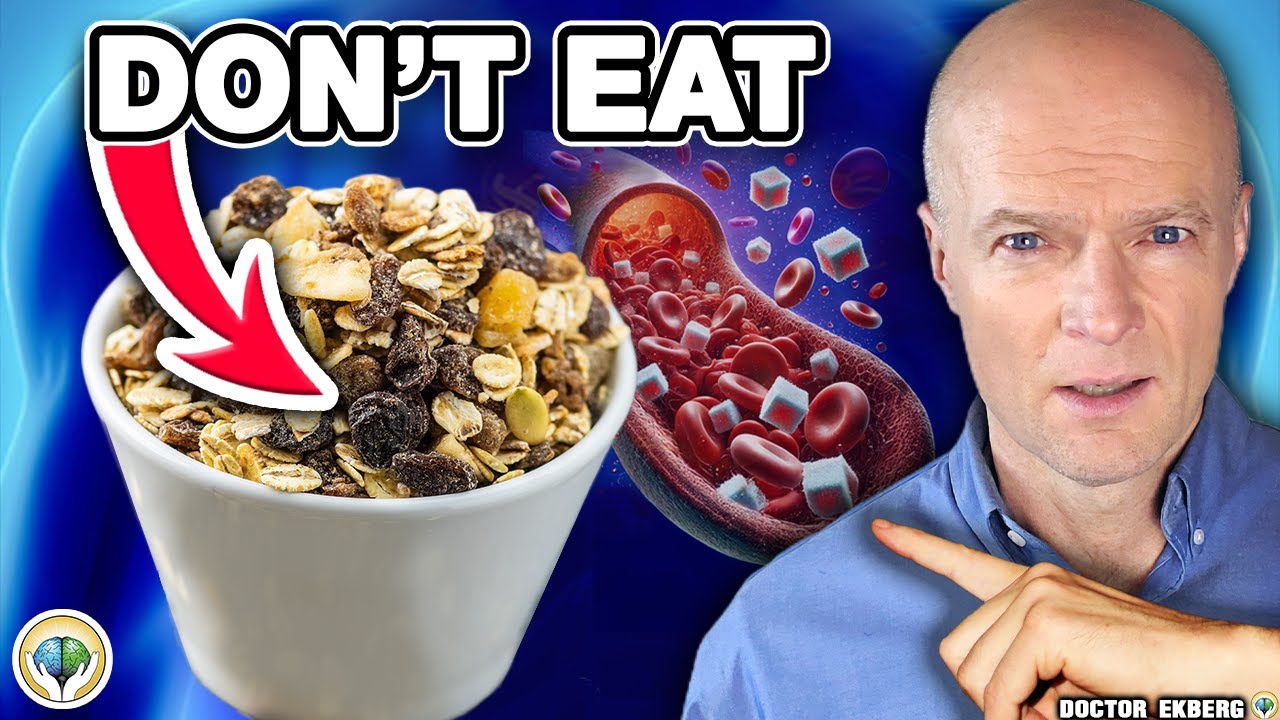
Breakfast cereals are positioned as a common place where people accidentally start the day with a glucose surge.
The analysis compares dry product per 100 grams, focusing on net carbs, the portion that becomes absorbable carbohydrate.
The numbers are striking:
Even plain oatmeal, which looks better, is still described as a high-carbohydrate food. The main difference is often the added sugar.
Sugar per 100 grams is compared too:
What makes this section feel practical is the conditional “question mark” approach. Plain oatmeal is not automatically endorsed, but it is treated as the least problematic of the group, especially if it is steel-cut and used occasionally.
If you are trying to control blood sugar tightly, the argument is that even these “healthier” porridges may still be too carb-heavy.
4) “Healthy snacks” that behave like dessert
Packaged snacks are where marketing often wins.
Granola bars, protein bars, and trail mix are presented as “healthy alternatives to candy,” but the macro breakdown is used to show they can land in the same metabolic category.
Per 100 grams:
Then comes the key exception. A “plain” trail mix made only of nuts and seeds drops to about 26 g net carbs and about 4 g sugar per 100 grams.
But even there, the analysis stays granular. Many trail mixes include cashews and pistachios, which are among the higher-carb nuts. If you make your own with almonds, pecans, walnuts, macadamias, and some seeds, the claim is you can get closer to 5% net carbs, with around 1 g sugar per 100 grams.
This is a real-world application point: you do not have to give up snacks, but you may need to stop outsourcing “healthy” decisions to packaging.
A simple way to use this viewpoint: if a snack is built on grains, syrups, dried fruit, or candy pieces, treat it like dessert, not like fuel.
»MORE: Build a “blood sugar steadier” snack list by choosing a protein plus a fiber food, for example eggs plus vegetables, or plain yogurt plus nuts, rather than bars marketed as “protein.”
5) Candy, sugar alcohols, and the dark chocolate loophole
Candy is the easy one. Regular candy is treated as a clear “no.”
What gets more nuanced is the comparison between sugar-free products and different cocoa percentages.
Sugar-free candy is not automatically harmless
Two sugar-free approaches are criticized:
Research on non-nutritive sweeteners is complex and can vary by sweetener type and individual response. Some studies suggest they may affect appetite, gut microbiome, or glucose tolerance in certain contexts, while others show neutral or beneficial effects when they replace sugar. If you use them, it may help to monitor your own cravings and intake patterns and discuss choices with a clinician if you have diabetes (NIH overview of non-nutritive sweetenersTrusted Source).
Dark chocolate, the percentage matters
This section is unusually specific:
The practical mechanism offered is that higher-cocoa chocolate contains more fat and is more satiating, which may slow absorption and reduce the urge to overeat.
Expert Q&A
Q: Is “sugar-free” candy a good strategy if I crave sweets?
A: It can be a mixed bag. Some sugar alcohols can still raise blood sugar for certain people, and some can cause digestive upset. If sugar-free sweets keep cravings alive and lead to overeating later, it may not help your long-term goals.
A more practical experiment is to test a small portion, watch your hunger and your glucose response (if you monitor), and decide based on your own pattern.
Health educator perspective based on the video’s framework
6) Yogurt: when it helps, and when it turns into soda
Yogurt is not condemned as a food, but sweetened yogurt is treated like candy.
Three categories are compared:
The strongest warning is for fruit yogurt. The sugar content is described as up to 30 grams per serving, and the point is made that it can be “sweeter than Coca-Cola” because the serving is smaller.
Frozen yogurt is treated as a “joke” nutritionally, essentially another dessert.
Plain, full-fat yogurt gets a question mark and a check mark. The check mark depends on fermentation time.
The mechanism is explained in a simple way: milk contains lactose, a sugar. During fermentation, bacteria convert lactose into lactic acid. More sour yogurt suggests more lactose has been consumed.
A specific DIY method is offered:
This is a very specific viewpoint, and it will not fit everyone. People with lactose intolerance, milk protein allergy, or certain digestive conditions may still react to yogurt even if lactose is reduced.
Pro Tip: If you buy plain yogurt, choose the one that tastes tangy and check the label for “added sugar.” If it tastes like dessert, it probably functions like dessert.
7) Starchy snacks and “vegetable chips” cooked in seed oils
Potato chips are the obvious example.
The bigger point is that many crunchy snacks are essentially starch turned into glucose, regardless of whether the package says “baked,” “whole grain,” or even “made from vegetables.”
The list includes potato chips, baked chips, crackers, pretzels, rice cakes, popcorn, and “vegetable chips and sticks.” The critique of vegetable chips is specific: manufacturers often extract the starchy portion, then deep fry it.
Seed oils are emphasized here as a second hit. The argument is that these products are typically fried in commercial seed oils that are very high in omega-6 fats and are “destroyed oils” after high-heat processing.
Mainstream nutrition science recognizes that deep-fried ultra-processed foods are associated with poorer cardiometabolic outcomes, even though debates about specific oils can get heated. If you are trying to improve blood sugar control, reducing fried snack foods is a widely supported move (American Heart Association on fried foods and heart healthTrusted Source).
8) Fast food and deli: the combo of starch, sugar, and additives
Fast food is framed as a predictable pattern, not a single item.
The foods listed include burgers and fries, hot dogs, fried chicken, chicken sandwiches, and Subway-style sandwiches.
The critique is multi-part:
A Subway-style sandwich is described as only slightly better because you can choose more vegetables, but the improvement is limited because the bread and sauces remain major contributors.
Deli meats are treated with nuance. The deli meats inside a typical sandwich are criticized for long ingredient lists, sugar, preservatives, and texture additives. But higher-quality deli counter meats with simple ingredients, ideally from animals raised more naturally, are treated as “totally okay” once in a while.
This section is a reminder that blood sugar management is often about removing the default, not chasing perfection. If fast food is frequent, even small improvements matter, such as skipping the bun, choosing water, and avoiding sweet sauces.
Important: If you have high blood pressure, kidney disease, or heart failure, processed meats and restaurant foods can be very high in sodium. Talk with a clinician about your personal limits.
9) Alcohol: the liver burden, plus hidden sugar in mixed drinks
Alcohol is separated into two problems: immediate blood sugar effects for some drinks, and longer-term metabolic stress through the liver.
A standard drink is defined as about 14 grams of alcohol:
Then the sugar and carb differences are highlighted:
A distinctive claim is that fructose is almost as bad as alcohol gram for gram for the liver, and that in mixed drinks the sugar may be “worse than the alcohol” for liver damage.
From a mainstream standpoint, alcohol intake is associated with multiple health risks, and several organizations recommend limiting intake, or avoiding it, especially for people with liver disease or certain cancer risks (CDC alcohol and healthTrusted Source).
Still, the video offers practical harm reduction guidance for people who will drink:
Expert Q&A
Q: If I am trying to lower my blood sugar, is any alcohol “best”?
A: If you drink, the framework here favors options with minimal sugar, such as dry wine or distilled spirits, and avoiding mixed drinks that can add 20 to 40 grams of sugar. Quantity and frequency matter as much as the type.
If you have diabetes, fatty liver, high triglycerides, or take medications that interact with alcohol, it is worth discussing alcohol limits with your clinician.
Health educator perspective based on the video’s framework
10) Vegan and gluten-free alternatives that spike harder
The warning is not about vegan or gluten-free eating, it is about ultra-processed substitutes.
This section targets “alternative products” that try to mimic the original food but often rely on refined starches and industrial ingredients.
Examples include vegan ice cream, vegan fast food, vegan meats, gluten-free bread, and sweetened plant milks.
The claim about gluten-free bread is especially pointed: when manufacturers remove wheat and gluten, they often replace structure with tapioca starch, corn starch, potato starch, or rice starch, which may spike blood sugar even more than white bread.
Plant milks get a simple rule: choose unsweetened, because some versions compensate for bland flavor by adding sugar.
Meat substitutes are criticized as “franken foods,” with mention of textured vegetable protein and even the idea of 3D printed substitutes. The practical advice is to choose whole foods as much as possible if you eat vegan.
A balanced interpretation is that many people can thrive on plant-forward eating patterns, but blood sugar outcomes depend heavily on the degree of processing and the carbohydrate profile. Whole legumes, vegetables, nuts, and minimally processed foods behave very differently than starch-based vegan desserts and refined gluten-free baked goods.
Key Takeaways
Frequently Asked Questions
- Is fruit juice really as bad as soda for blood sugar?
- This video’s perspective is that fruit juice is largely sucrose (about 50% glucose and 50% fructose), so it can behave similarly to other sugary drinks. For many people trying to manage blood sugar, whole fruit is typically a steadier choice than juice because it contains fiber.
- Are whole grains okay if I have prediabetes?
- The viewpoint here is that whole grains may be better than refined grains, but they can still be high glycemic and may not support tight blood sugar control. If you have prediabetes, it can help to test your response and talk with a clinician or dietitian about portions and frequency.
- Is plain oatmeal a good breakfast for blood sugar control?
- Plain oatmeal is treated as “less bad” than sugary cereals, especially steel-cut oats, but still relatively high in carbohydrates. If you are sensitive to blood sugar swings, it may be worth experimenting with portion size and adding protein and fat to slow absorption.
- What is the best type of yogurt for blood sugar?
- Sweetened fruit yogurts and frozen yogurt are flagged as high-sugar choices. Plain, full-fat yogurt is treated more favorably, especially if it is more sour, which suggests longer fermentation and potentially less lactose.
- If I want chocolate, what percentage cocoa should I choose?
- The recommendation in this video is to aim for 85% cocoa or higher. The reasoning is that it contains less sugar, is more filling, and a typical serving may only provide a few grams of sugar.
Get Evidence-Based Health Tips
Join readers getting weekly insights on health, nutrition, and wellness. No spam, ever.
No spam. Unsubscribe anytime.