A Doctor’s Take on David Dobrik’s Weight Loss

Summary
David Dobrik’s transformation is entertaining, but the most useful parts are the health lessons hiding underneath the before and after photos. This doctor’s reaction focuses less on chasing a perfect body fat number and more on sustainable habits, realistic expectations, and long-term risk. Key themes include why excess weight matters for future health, why exercise alone often fails without diet structure, how high protein intake can help preserve muscle during weight loss, and why frequent DEXA scans can be more “wow moment” than medical necessity. The journey also highlights how travel, fast food, soda, and alcohol can quietly erase progress.
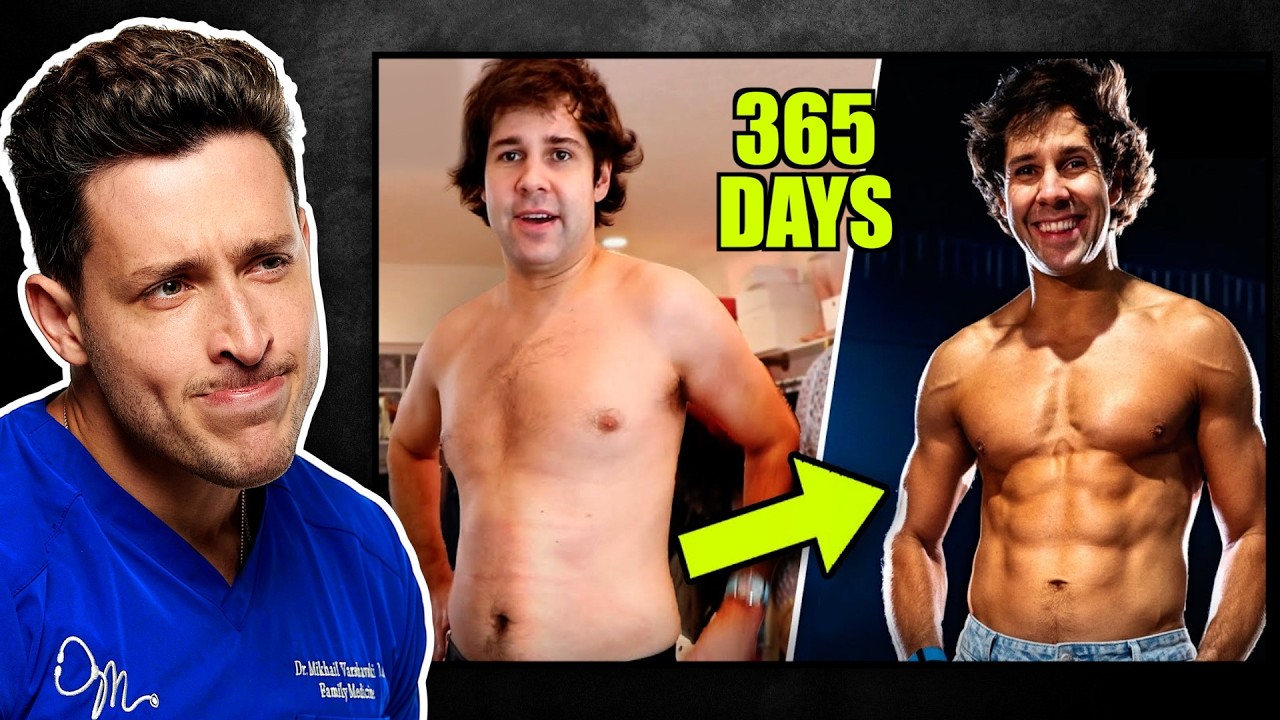
Health transformations go viral because they look dramatic.
But the more important question is what they do to your long-term wellbeing.
In this reaction to David Dobrik’s weight loss, the clinician keeps circling back to a practical point: the goal is not just to look different for a moment, it is to reduce health risk and build something you can live with. That perspective changes how you think about body fat numbers, “perfect” celebrity physiques, fast-food calories, and even how often you should scan your body.
Why this transformation matters beyond aesthetics
Being “fine right now” is not the same as lowering future risk.
A key theme in the reaction is the idea of time horizon. Someone can carry extra weight and still have normal labs today, feel okay, and function well. This framing still treats extra weight as meaningful because it can raise the odds of problems later, like cardiometabolic disease, joint issues, sleep apnea, and fatty liver disease. The emphasis is not fear, it is planning.
This is also why the reaction pushes back on a common internet debate: “You can be overweight and healthy.” That can be true in the present. The argument here is that health is not only a snapshot, it is a trajectory.
What’s interesting about this approach is that it gives you a reason to change that is not rooted in self-hate. If your motivation is only “I look bad,” you may be more likely to do extreme, short-term behaviors. If your motivation is “I want to improve my odds over the next 10 to 30 years,” you are more likely to tolerate slower progress and build repeatable routines.
Did you know? Even modest weight loss can improve health markers in many people. For example, the CDC notes that losing 5% to 10% of body weight may lead to improvements in blood pressure, cholesterol, and blood sugar in adults with overweight or obesity (CDC overviewTrusted Source).
Body shaming vs health goals, a line worth protecting
The video opens with a moment many viewers recognized instantly: David sees an unflattering screenshot and says, “I know I’m too fat,” then the content leans into embarrassment and jokes.
The reaction is direct about not liking that tone.
There is a difference between choosing a goal and mocking your body to get there. The clinician’s concern is not only for David, it is for the audience. When millions of people watch someone ridicule their own body, it can normalize harsh self-talk and trigger shame, especially for viewers with a history of disordered eating or body image distress.
At the same time, the reaction makes an important distinction: discussing weight loss for health is not the same thing as “fatphobia.” In a clinical context, conversations about weight often exist because body weight can be associated with future health risk. That does not mean every body needs to look a certain way, and it does not justify humiliation as motivation.
A more useful mindset than “before body” jokes
If you are trying to make changes, consider swapping the question “Do I look bad?” for questions like:
Pro Tip: If progress content makes you spiral into shame, try tracking performance goals instead of appearance goals for a month, like number of workouts completed, daily steps, or how many servings of protein you hit.
DEXA scans, helpful tool, imperfect scoreboard
DEXA is not magic, it is measurement with margins.
A big part of the transformation storyline is the repeated DEXA scans. The reaction explains what a DEXA scan is in medicine: it is commonly used for bone density testing to evaluate osteopenia and osteoporosis. It can also estimate body composition, including fat mass and lean mass, and is often treated as a “gold standard” in fitness settings.
Then comes the nuance. Even if DEXA is a strong tool, it is not a flawless truth machine. The reaction highlights factors that can change results from scan to scan, including hydration status, sex, disease state, the machine model, and software updates. That matters because people can interpret small changes as “I failed” or “I gained fat,” when part of the shift may be measurement variability.
In the video, David’s early scan shows 27.8% body fat, and later numbers move down and up across travel periods. The reaction repeatedly returns to the idea that you should not make a single number your identity.
What the research shows: DEXA can estimate body composition, but results can vary based on technical and biological factors. For a general overview of how body composition methods differ and why results can vary, see the NIH National Institute of Diabetes and Digestive and Kidney Diseases discussion of weight and health measures (NIDDKTrusted Source).
The “treat the patient, not the lab value” lesson
One of the most memorable lines in the reaction is essentially: treat the person, not the number.
This matters because transformation content often trains people to chase a scoreboard, body fat percentage, scale weight, BMI, or a single photo angle. The reaction argues that the “wow moment” could have been achieved with before-and-after photos, without repeated scans.
There is also a safety angle. DEXA uses low-dose radiation, and a single scan is generally considered low risk. But the reaction raises a reasonable question: if someone is doing scans frequently for entertainment, is it necessary? Radiation dose adds up over time, and in medicine, imaging is usually justified by a clinical need.
Important: If you are considering repeated body composition scans, it is reasonable to ask your clinician what decision the scan will change. If the answer is “none,” you may be paying for anxiety more than insight.
Diet realities: calories, protein, and “eating whatever”
The transformation story hits a common fantasy: getting lean while still eating whatever you want.
The reaction does not treat this as moral failure. It treats it as math, biology, and environment.
Calories in, calories out, still applies
The clinician pushes back on the internet habit of “dunking” on calories in versus calories out. The framing is practical: conditions that change your ability to exercise affect calories out, and conditions that increase hunger affect calories in. But the principle remains that energy balance matters.
This is not saying weight loss is easy. It is saying the mechanism is not mysterious.
A helpful mainstream reference is the NIH NIDDK overview of the health risks of overweight and obesity and how lifestyle factors influence weight over time (NIDDKTrusted Source).
The protein target in the video, and why it shows up so often
A specific detail from the documentary is the plan to aim for about 200 g of protein per day at a body weight around 180 lb. The reaction notes this is slightly over 1 gram per pound, and calls it “fine,” while acknowledging debate about protein targets.
The underlying logic is muscle retention. When you lose weight, you often lose some lean mass along with fat mass. Higher protein intake can help preserve lean mass, especially when paired with resistance training. The reaction also makes a realistic point: even with high protein, some muscle loss can still happen, which is why physique athletes cycle between “bulking” and “cutting” rather than staying shredded year-round.
For readers who want a research-based anchor, the International Society of Sports Nutrition position stand discusses protein needs in active people and notes that higher intakes can be appropriate depending on goals and context (ISSN position standTrusted Source).
Why refined carbs and fast food can feel like “progress killers”
The reaction is careful here. Eating fries or drinking a cola is not automatically “bad.” The issue raised is behavioral and physiological: highly refined carbs and sugary drinks can be easy to overconsume, less satiating for many people, and can contribute to hunger swings that make it harder to stay in a calorie deficit.
Then there is the travel reality. Ordering a “30 strip bucket” for layovers is a vivid example. Whether or not the stated calorie number is exact, the point stands: large, hyper-palatable meals can silently wipe out a week of careful choices.
A practical way to use this insight without demonizing foods is to treat “fun foods” as planned, not constant.
Training takeaways: start smart, mix modalities, rest matters
The reaction repeatedly downshifts the hype around workouts.
Exercise is valuable for health and body composition, but it is not the only lever, and for many people it is not the biggest lever for weight loss.
Don’t go from couch to miles overnight
One early moment shows David going from sedentary to running miles quickly. The reaction warns that jumping too fast can lead to soreness or injury, and injuries can be demotivating enough that people quit altogether.
Consistency beats intensity.
If you are restarting movement after a long break, a safer pattern is to scale gradually, like alternating walk and jog intervals, increasing weekly volume slowly, and paying attention to joint pain.
A mixed training approach, not just endless cardio
The reaction highlights a blend of training styles:
This is a very “real gym” detail, and it reflects a common approach in physique and general fitness programs.
Resource callout: Want a simple starting point? Draft a weekly plan with two strength days, two cardio days, and one longer walk. If you have medical conditions, injuries, or are new to exercise, consider checking in with a physical therapist or clinician before ramping up.
Rest days are not laziness
Later, the documentary introduces a plan that includes working out every day, specifically 30 minutes of steady-state treadmill cardio. The reaction pushes back: you do not need to work out every day, and rest days matter.
That does not mean you must be sedentary. A rest day can be gentle movement, mobility work, or an easy walk. The point is to avoid treating your body like it has infinite recovery capacity.
Travel, alcohol, soda: the quiet progress killers
Most plateaus are not mysterious, they are environmental.
The documentary shows a pattern many people recognize: progress at home, then travel, then “sloshed” weeks, then a scan that shows body fat up and muscle down.
Alcohol does not only add calories
The reaction makes two separate points about alcohol:
The clinician gives a vivid example of how a night can stack up: it can be easy to drink 1,000 calories, then add another large amount from food afterward. You do not need to track every number to understand the pattern.
For alcohol health guidance, the CDC summarizes how alcohol affects health and emphasizes moderation and risk awareness (CDC alcohol and healthTrusted Source).
Soda, including diet soda, and why “no soda” was included
The 75-day challenge includes no soda at all, including no diet soda, and David mentions drinking about five Diet Cokes a day.
The reaction wonders why diet soda was targeted specifically. The documentary frames it as a habit-building and self-control move, not necessarily a statement that diet soda is uniquely harmful.
From a practical standpoint, removing soda can help in a few ways:
Research on nonnutritive sweeteners is complex and can vary by person and pattern of use. If you are considering major changes, it can help to discuss your overall diet and cardiometabolic risk with a clinician. For general dietary guidance, the American Heart Association offers practical recommendations on added sugars and healthy eating patterns (AHA nutritionTrusted Source).
The 75-day challenge, structure helps, but habits are harder
The documentary introduces the “75-day David do challenge” after about two months of stalled progress. The plan has four elements: diet changes toward higher-protein meals, calorie tracking, daily workouts, and no soda.
Structure can be powerful.
But the reaction adds an important correction: doing something for 75 days does not guarantee lifelong habits, and evidence on habit formation suggests it is more complicated than a single fixed timeline. Some habits lock in quickly, others take much longer, and many depend on environment and stress.
Tracking, useful tool, not a moral requirement
The reaction offers a balanced view on calorie tracking. Tracking is not “absolutely necessary” for everyone, but it can be valuable to learn what is in typical foods and reduce underestimation. Many people underestimate sugar and overestimate protein, especially with “healthy-sounding” meals.
A practical way to use tracking without becoming obsessive is to treat it as a temporary education phase.
Expert Q&A
Q: Do I need to hit a specific body fat percentage to be healthy?
A: This perspective argues no. A single body fat number is best treated as one data point alongside blood pressure, lipids, blood sugar, fitness, sleep, and how you feel day to day. If you want a target, consider focusing on behaviors you can repeat, like strength training twice a week and eating protein at most meals.
Video clinician, MD
Celebrity bodies and unrealistic expectations
David names Tom Holland as a “dream body.” The reaction responds with a reality check: celebrity physiques are often produced by paid training, strict dieting, professional lighting, and sometimes performance-enhancing drugs or hormone use. Even when a celebrity is natural, they may not look that way year-round.
This matters for mental health. If your goal is a body that someone else maintains with a team, you might interpret normal fluctuations as failure.
Expert Q&A
Q: Why does the scale stop changing when I start working out?
A: Early on, weight can drop quickly from water changes, then stall as you gain some muscle while losing fat. The reaction emphasizes looking at performance improvements and how clothes fit, not only the scale. If you want numbers, consider waist measurements or progress photos taken in consistent lighting.
Video clinician, MD
Key Takeaways
Frequently Asked Questions
- Is DEXA the best way to measure fat loss?
- DEXA is a commonly used tool for body composition, but results can vary with hydration, machine differences, and other factors. It can be helpful, but it is usually best used alongside other measures like how you feel, performance, and basic health markers.
- Why did progress stall when David kept eating fast food?
- The core issue highlighted is that fast food can be calorie-dense and easy to overeat, especially during travel. Even with workouts, a consistent calorie surplus can slow or reverse fat loss.
- Do you have to track calories to lose weight?
- Tracking is not required for everyone, but it can help you learn portion sizes and the calorie and protein content of common foods. Some people use it short-term to build awareness, then transition to simpler routines.
- Is it bad to drink diet soda during weight loss?
- The video frames removing diet soda as a consistency and self-control strategy, not necessarily because diet soda is always harmful. If diet soda affects your appetite, sleep, or snacking habits, reducing it may help, and it can be worth discussing with a clinician if you have specific health concerns.
Get Evidence-Based Health Tips
Join readers getting weekly insights on health, nutrition, and wellness. No spam, ever.
No spam. Unsubscribe anytime.