A Doctor’s Take on MrBeast’s 100-Lb Weight Loss Bet

Summary
A clinician reacts to MrBeast’s video about “trapping” a participant in a circle until he loses 100 pounds, and the reaction is more nuanced than hype. The core themes are sustainability over spectacle, why single weigh-ins can mislead, how calories and protein matter even with “healthy” foods, and why rest days and medical monitoring are essential. The discussion also turns unexpectedly serious when the participant’s coach dies, highlighting how grief and isolation can affect health behaviors. The participant later shares his “four pillars” (sleep, nutrition, hydration, activity) and the clinician adds a key tip: find a primary care doctor you trust to separate fact from fiction.
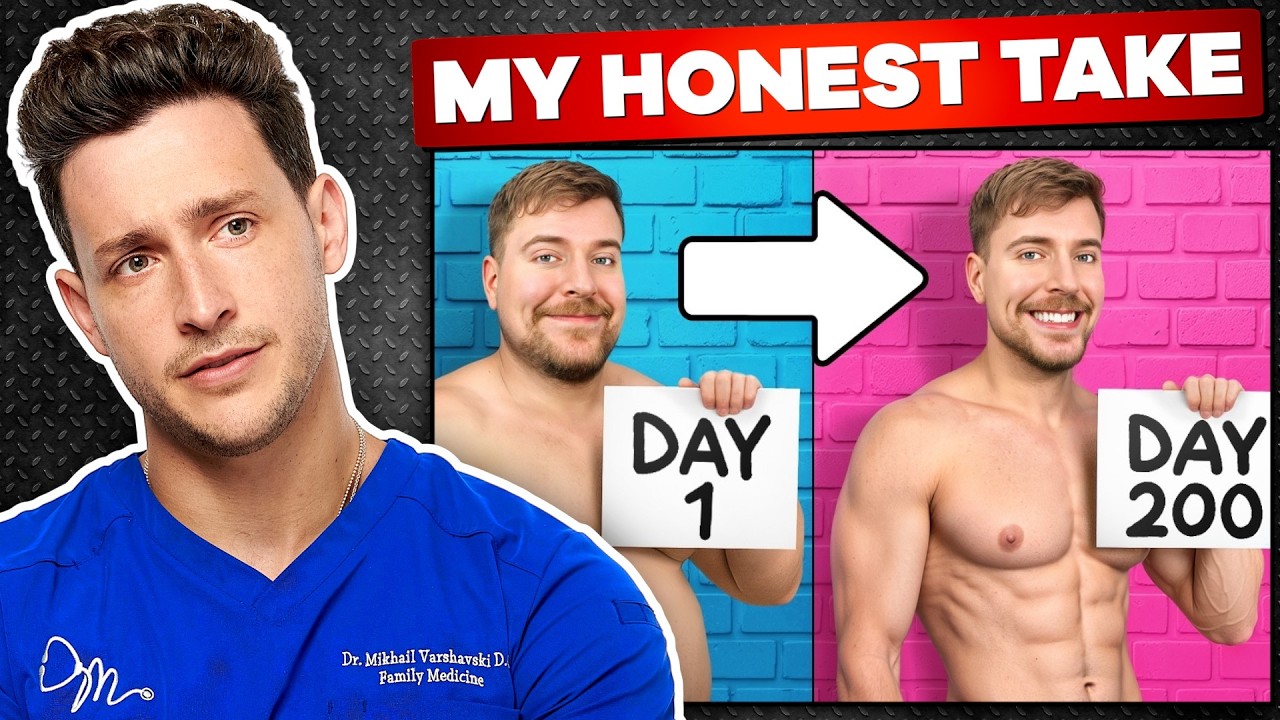
The moment that set the tone: skepticism, worry, optimism
The video opens with a line that sounds like a parody of wellness culture: MrBeast “trapped a guy in a circle until he lost 100 pounds.”
The clinician reaction is immediate and conflicted. The concern is not just whether the participant can lose weight, it is whether the process teaches a healthy method and sends a responsible message to viewers.
That framing matters because weight loss content has a long history of rewarding extremes. The discussion explicitly references prior TV formats where contestants lost weight fast and then regained it because they were not taught sustainable habits. This is the shadow hanging over the entire challenge.
What’s interesting about this approach is that it does not fully reject the idea. The mood is “skeptical, worried, but optimistic.” In other words, it is possible for a dramatic challenge to include real guardrails, like rest days and medical checkups, but the spectacle itself can still distort what people learn.
Important: If a weight loss plan depends on isolation, constant pressure, or “punishment” challenges, it can increase stress and injury risk. If you are trying to lose weight, it is worth discussing your plan with a clinician who knows your medical history.
Is 100 pounds in a year “healthy”, and what does that even mean?
MrBeast sets the bet: lose 100 pounds in one year for $250,000.
The clinician does quick math out loud. A year is 52 weeks, so the pace is roughly 2 pounds per week. That is fast, but the reaction is nuanced: it is “a lot” and “fast,” yet not necessarily the most extreme form of weight loss.
This is a useful distinction for real life. “Healthy” weight loss is not a single number. It depends on starting weight, medical conditions, medications, mobility, sleep, mental health, and whether the plan is sustainable. Many clinical resources describe a more modest pace as typical for long-term maintenance, often around 1 to 2 pounds per week for some people, but your clinician may recommend a different target depending on your situation.
Mechanistically, faster early loss can happen for reasons that are not all fat loss. When someone changes their diet sharply, glycogen (stored carbohydrate) and the water stored with it can drop quickly. Salt intake changes can also shift water retention. This is one reason the first month can look dramatic.
Another theme here is that the goal is not just a smaller body. It is a healthier body that can be maintained after the cameras stop. Behavioral skills, cooking competence, and a realistic relationship with exercise become the real “prize,” even if the video’s prize is money.
Did you know? Large body weight changes can shift blood pressure, blood sugar, and medication needs. That is one reason many guidelines emphasize medical supervision for major weight loss, especially if you have diabetes, hypertension, sleep apnea, or take daily prescriptions. For general background on obesity and health risks, see the CDC’s overview of adult obesityTrusted Source.
“Healthy food” vs calorie math: why both matter
Early in the challenge, the participant goes from “PB and Js, energy drinks” to omelettes and a plate that looks, in the clinician’s words, “extremely healthy.”
Then comes the key correction: micronutrients and macronutrients matter, but calories still matter.
This perspective is practical. You can eat foods that look virtuous and still gain weight if total energy intake exceeds what your body uses. Calories represent energy, and weight loss generally requires a sustained energy deficit over time.
At the same time, the video does not reduce nutrition to math alone. The clinician keeps returning to the idea that the “takeaway” should be what the participant is actually eating, not just the calorie number. That is a subtle critique of weight loss entertainment. Viewers often copy the headline number (2,500 calories, 18,000 steps) without understanding food quality, protein intake, and what is realistic for their own body.
Smoothies, whey protein, and why chewing matters
A standout segment is the participant making his “first smoothie ever,” adding a scoop of protein.
Whey protein is framed as a convenient way to increase protein intake without adding many extra calories. For many people, higher protein intake can improve satiety and help preserve lean mass during weight loss.
But the clinician adds a caution that is easy to miss in generic advice: smoothies and juices can make it easy to overconsume fruit. When fruit is blended or juiced, you can drink the equivalent of multiple servings quickly, often with less fullness. There is also “something to be said about the act of chewing,” which relates to satiety signaling and how quickly you consume calories.
The suggested pivot is specific: choose fruits with more fiber and lower sugar density, like berries, rather than building a drink around many oranges.
For readers who want a research-based anchor, fiber is consistently associated with better cardiometabolic health. The American Heart Association’s fiber guidanceTrusted Source explains how fiber supports digestion and may help with cholesterol and blood sugar management.
Pro Tip: If you like smoothies, try building them around protein plus fiber. For example, Greek yogurt or whey protein, berries, and a spoon of chia or ground flax can feel more filling than fruit alone.
Tracking, weigh-ins, and the psychology of numbers
The challenge includes monthly weigh-ins, and the first one shows a dramatic drop: 20 pounds in 30 days.
The reaction is not celebration first. It is skepticism about measurement.
Single weigh-ins are described as “not incredibly useful” because weight fluctuates for many reasons: water status, recent food intake, exercise, stress, and even microbiome changes. The recommended approach is trend-based, such as weighing at the same time across several days and using an average.
This matters because weight loss content often creates a false sense of precision. People then interpret a normal fluctuation as failure, and that can trigger restriction, overtraining, or giving up entirely.
This section also raises a psychological point: the video gamifies progress with money. Push-ups add $1,000 each. Carrying duffel bags of cash adds to the prize pool. A mile under 8 minutes 30 seconds adds $25,000. That is entertaining, but it can teach viewers that health is a series of pass or fail tests.
The clinician even questions MrBeast’s role in the game. Is he cheering participants on, or discouraging them to lose? The uncertainty is not just about personality, it is about what gamification does to motivation.
A practical everyday translation is simple: if you track weight, steps, or calories, use them as feedback, not as a moral scoreboard.
What the research shows: Long-term weight management tends to be more successful when people build sustainable routines and self-monitoring habits they can maintain, rather than relying only on short bursts of extreme effort. For a broad overview of behavioral strategies used in clinical weight management, see the National Institute of Diabetes and Digestive and Kidney Diseases (NIDDK) weight management resourcesTrusted Source.
Training hard without breaking down: steps, lifting, cardio, rest
The exercise plan in the video is intense. The participant is doing up to 18,000 steps per day, lifting 5 days a week, and eating around 2,500 calories a day.
The clinician agrees that 2,500 calories for someone at that size is “definitely at a deficit,” especially with exercise layered on top. The reminder is immediate: make sure you are consuming your proteins.
Then comes a take that will resonate with many people who have used wearables.
“I have a love-hate relationship with step counters.”
The concern is not that walking is bad. It is that obsessing over steps can create a toxic relationship with exercise, where movement becomes a daily quota and guilt engine. The suggested alternative is to aim for general mobility and then track higher-intensity training more intentionally.
Rest days are not optional
A pivotal moment in the video is when MrBeast says they made sure the participant took rest days and got weekly checkups from a doctor.
The clinician’s reaction is relief. Rest days are described as “absolutely crucial,” and training should have variations in intensity. The example given uses running: tempo runs, endurance runs, walking recovery days, and a day where you “shut it all off.”
This matters physiologically. Adaptation happens when your body repairs after stress. Without recovery, fatigue accumulates, injury risk rises, and sleep and mood can worsen.
If you are building an exercise routine from scratch, this pattern can be a safer starting point:
For general physical activity targets, the CDC physical activity guidelinesTrusted Source provide a practical baseline many clinicians use when counseling patients.
Injury risk is real: joints, tendons, and the dead-hang lesson
The video’s challenges escalate from push-ups to a fast mile to dead hangs and pull-ups.
The clinician repeatedly returns to one theme: when you are overweight and doing new movements, it is easy to get hurt fast.
That is not fearmongering, it is biomechanics. Higher body weight increases load on joints during impact activities like running. Rapid increases in training volume can outpace tendon adaptation, which is slower than muscle adaptation.
A concrete example is the dead hang challenge. Hanging for time can stress the forearms, grip, shoulders, and elbows. The clinician specifically warns about medial epicondylitis (often called “golfer’s elbow”), describing a personal story of developing it from dead hangs.
The story goes further than the usual “be careful.” It includes a cautionary tale about seeking care, trying acupuncture, then having a nerve injury type sensation after a second session, followed by a “shady doctor” visit. The takeaway is not that acupuncture is good or bad, it is that desperate people can be vulnerable to questionable care when they are in pain.
The video also highlights training tools that make progression safer, like resistance bands attached to a pull-up bar. That is a practical, scalable method: reduce the effective load so you can practice the movement pattern.
Important: If you develop sharp pain, numbness, tingling, or weakness during training, it is worth stopping and seeking medical advice. Nerve symptoms, especially, should not be “pushed through.”
When the story turns to grief: isolation, stress, and coping
Midway through the challenge, the participant’s coach is found dead.
The video becomes emotionally heavy, and so does the analysis.
The clinician comments on the communication style used when delivering the news, noting that offering a hug, then staying quiet and allowing processing, is a high-level supportive approach.
Then the discussion shifts into mental health education that is rarely included in weight loss content.
The loss of a loved one is called bereavement. The emotional response is grief.
A key point is stated plainly: bereavement and grief are not, by themselves, psychiatric conditions. They can become complicated, including a condition called prolonged grief disorder, but acute grief does not automatically require therapy or medication. Many people benefit from family, community, faith leaders, or supportive clinicians, and many people are resilient.
This is especially relevant here because the participant is also in isolation and in a caloric deficit. The clinician describes that combination as a high-stress state: restricted calories stress the body, isolation stresses mind and body, and grief can predispose psychiatric conditions to flare, including depression, anxiety disorders, and PTSD.
The participant chooses to continue, reframing the mission as “for coach too.” That is highlighted as a coping mechanism: keeping someone alive in your memory and using meaning to sustain behavior.
There is also a brief, serious note about the reported cause of death involving an illicit substance with opioid-like effects. The warning is direct: be careful with illicit substances.
Q: If grief makes me lose motivation, does that mean something is wrong with me?
A: Not necessarily. Grief can disrupt sleep, appetite, energy, and concentration, and that can make exercise and meal planning feel impossible for a while. Many people need support and time, not a “fix.”
If symptoms become severe, last for months without easing, or include thoughts of self-harm, it is important to reach out to a clinician or mental health professional promptly. A primary care doctor can also help you sort out what is a normal grief response versus something that needs additional care.
Dr. A. Patel, MD, Internal Medicine
The most valuable scene: wearing the 97-pound “fat suit”
Late in the video, the participant tries on a bodysuit that replicates his day-one body. The suit weighs 97 pounds, essentially putting him back at his starting weight.
The clinician calls this “probably the most valuable thing of this video.”
It is easy to dismiss as a gimmick, but the point is quality of life. Carrying excess body fat to a high degree can shorten lifespan, but it also changes daily living: walking hurts more, stairs become daunting, social activities feel less accessible, and self-image can deteriorate.
The analysis also addresses a common online accusation: that discussing weight loss is “fat phobic.” The rebuttal is that the concern is not aesthetics. It is function, health, and the way quality of life can shrink when mobility and confidence decline.
“The antithesis to happiness is loneliness,” the clinician says, linking physical limitation to social withdrawal.
This is also where the video makes a subtle but important body composition point. The clinician notes that scales can mislead when someone gains muscle while losing fat. Clothing fit and functional improvements can be more meaningful than the number.
Grip strength is used as an example of functional fitness. The claim is that grip strength after age 50 correlates with longevity. While the exact predictive value varies across studies, grip strength is widely used in research as a marker of overall strength and health status. For background on how clinicians think about muscle strength and aging, see the National Institute on Aging guidance on exercise and older adultsTrusted Source.
Match’s four pillars, plus the clinician’s best tip
At the end, the clinician speaks directly with the participant, Match, and the conversation becomes the most actionable part of the entire piece.
Match summarizes weight loss with “four pillars”: sleep, nutrition, hydration, and physical activity.
It is refreshingly unglamorous.
He gives specific targets that worked for him: drinking a gallon of water a day, sleeping 8 to 10 hours, and focusing nutrition on vegetables and protein without being “super fancy.” He also reframes physical activity as not only strength training, but also steps.
The clinician’s best tip is not a supplement or a hack. It is healthcare infrastructure: find a primary care doctor you vibe with.
That recommendation is about safety and sanity. A trusted clinician can help you separate fact from fiction, tailor advice to your conditions and medications, and monitor whether weight loss is happening in a sustainable way.
This is especially relevant because the video includes several numbers that could be misapplied by viewers:
A practical way to apply the “four pillars” without copying the stunt
You do not need a circle, a cash prize, or a YouTube production to use the underlying framework.
»MORE: If you are trying to lose weight and feel overwhelmed by online advice, ask your clinic for a referral to a registered dietitian, or look for evidence-based guidance through the Academy of Nutrition and DieteticsTrusted Source.
Q: Should I aim for 18,000 steps a day like in the video?
A: Not automatically. Step goals can be helpful, but the right number depends on your baseline activity, joint health, schedule, and how your body responds. A big jump in steps can irritate feet, knees, hips, or back, especially if you are also lifting or dieting.
A safer approach is to increase gradually, for example adding 1,000 to 2,000 steps per day for a week or two, then reassessing. If you have pain, dizziness, chest symptoms, or a medical condition that affects exercise tolerance, check in with your clinician.
Dr. L. Chen, MD, Family Medicine
Key Takeaways
Frequently Asked Questions
- Is losing 100 pounds in a year always unsafe?
- Not always, but it is a large change that should be individualized. Your starting weight, medical conditions, medications, and injury risk all matter, so it is wise to involve a clinician and focus on sustainability.
- Why can a single weigh-in be misleading?
- Body weight can swing day to day due to water retention, salt intake, recent meals, stress, and exercise. Looking at trends, like averages over several days at the same time, gives a clearer picture.
- Are step counters bad for weight loss?
- They can be helpful, but some people become overly fixated and feel guilty when they miss a target. If that happens, it may be better to track broader activity patterns and focus on consistency and recovery.
- Do smoothies help with weight loss?
- They can, especially if they add protein and fiber, but they can also pack in calories quickly. Many people feel fuller when they eat whole fruit rather than drinking blended or juiced fruit.
- What is the best professional to talk to about a weight loss plan?
- A primary care doctor can help you evaluate safety and coordinate labs, medications, and referrals. A registered dietitian can help translate goals into a realistic eating plan you can maintain.
Get Evidence-Based Health Tips
Join readers getting weekly insights on health, nutrition, and wellness. No spam, ever.
No spam. Unsubscribe anytime.