The Truth About Oats, Processing, Sugar Spikes
Summary
Most people argue about oats as if they are one single food, either “healthy” or “unhealthy.” The perspective in this episode is different: the health impact of oats depends heavily on processing and on what you eat them with. Using continuous glucose monitors, the host and Prof. Sarah Berry test finely ground instant oats versus less processed oats, and show how blood sugar responses can vary widely between people and meals. The discussion also explores why oats can still support heart health through beta glucan fiber, and how to think about glyphosate concerns without panic.
What most people get wrong about oats
The loudest oat debate usually starts with a false choice: oats are either a “superfood” or they are “basically sugar.”
This episode’s unique lens is more investigative, it treats oats like a case file. Same plant. Different processing. Different add-ons. Different person. Different outcome.
The core claim is simple but uncomfortable: you cannot talk about oats as one food. Steel-cut oats, rolled oats, instant oats, and finely ground oat flour can behave differently in the body, especially in how quickly their starch turns into glucose.
And yet, the discussion also pushes back against the idea that a glucose spike is the only thing that matters. Oats contain beta glucan, a special fiber with strong evidence for lowering LDL cholesterol, plus vitamins, minerals, and polyphenols. So the question is not “Are oats healthy?” It is closer to: Which oats, prepared how, for which person, and for what health goal?
Important: A rise in blood sugar after eating carbohydrate is a normal physiologic response. The concern raised here is about very large, frequent spikes, especially when they lead to a later dip that drives hunger and more eating.
An oat is a seed, but the factory decides your metabolism
Before the marketing, oats are a whole grain seed from the oat grass plant. The edible part includes an outer bran layer and an inner endosperm where most of the starch lives.
The episode gets unusually concrete about what is inside an oat. A typical oat seed is described as roughly 60 to 70 percent carbohydrate, around 10 percent protein (high for a grain), and it contains beta glucan fiber, B vitamins, minerals like magnesium, zinc, iron, and manganese, plus polyphenols.
Then comes the part most people skip: what happens to that seed before it lands in a bowl.
Here is the processing ladder described in the conversation, from least processed to most processed:
This is not just food trivia. This is the mechanism.
When you change the structure of a grain, you change the speed at which digestive enzymes can access starch. That speed is what shows up later as a faster or slower glucose rise.
The live experiment, two bowls, two glucose stories
The episode’s signature moment is not a lecture, it is a live test.
Both participants wear a continuous glucose monitor (CGM). They fast, then eat measured bowls of oats, and scan their glucose.
The setup (measured like a lab)
The details matter because they make the point that small changes can produce big differences.
One day they use less processed oats. Another day they use very finely ground instant oats that cook in the microwave in a couple of minutes.
The host notices something that becomes a clue: the finely ground oats feel stickier and gluey, compared with the more intact oats.
The baseline scan
Before eating, they scan fasting glucose.
Even before food enters the story, the episode highlights personalization: two people can start from different baselines.
The post-meal shock
After eating the finely ground instant oats:
One bowl produced a spike the host says he rarely sees anymore.
The episode then connects the number to lived experience. The host reports a headache. Sarah describes feeling full and “great,” and notes she often gets hungry quickly if she chooses the wrong breakfast.
That contrast is the episode’s thesis in miniature: the “same food” can feel different depending on structure, toppings, and person.
Did you know? CGMs measure glucose in interstitial fluid, not directly in blood, and readings can lag behind blood glucose changes. That is one reason a CGM is great for patterns, but not perfect for single-moment precision. You can learn more about CGM basics from the National Institute of Diabetes and Digestive and Kidney DiseasesTrusted Source.
Why processing changes blood sugar, the food matrix case
The key insight here is the food matrix, the structure of food, not just its nutrient list.
Two oat products can have nearly identical ingredients on paper, and still behave differently in your gut.
When oats are finely ground and precooked, the starch is easier for digestive enzymes to reach. More surface area means faster breakdown into glucose, and faster absorption.
The conversation uses a memorable metaphor. The host imagines piranhas tearing apart food, and Sarah gently translates it into physiology: enzymes break starch bonds into simple sugars like glucose. Smaller particles mean enzymes can “attack” more quickly.
This is also where the episode brings in external evidence. Sarah references clinical trials where participants ate different oat forms on different days.
The pattern described is consistent:
A related mechanistic study discussed from King’s College London compares whole rolled oats versus oat flour, and finds the more intact oats stay in the stomach longer, which contributes to a slower glucose rise.
This is not about demonizing carbs. It is about rate.
A rapid glucose rise can be followed by a sharper fall. In Zoe research, the episode notes, a glucose dip 2 to 4 hours after a big spike may drive hunger, increased food intake, and worse energy and alertness for some people.
What the research shows: Dietary patterns that emphasize whole grains are associated with lower risk of type 2 diabetes in large population studies. For example, a systematic review and meta-analysis found higher whole grain intake was linked with lower type 2 diabetes risk in dose-response fashion (BMJ, 2015Trusted Source). Oats are one whole grain within that broader pattern, but the episode’s point is that form and context still matter.
Why Sarah’s toppings changed the result
Sarah does not “hack” the oats with a supplement. She builds a meal.
Her toppings include a measured mix of nuts, seeds, dried berries, plus 20 grams of nut butter. She frames this as adding fiber, protein, and healthy fats.
Those components can change glucose response in several overlapping ways:
In the episode’s language, the toppings “modulate” the glucose rise, meaning they change it, in this case, slowing and reducing the peak.
This is an important nuance: Sarah’s glucose still rises with instant oats, but not as sharply as the host’s plain bowl.
Pro Tip: treat oats like a base, not a finished breakfast
Pro Tip: If oats tend to spike your glucose, try adding a protein and fat source (for example, Greek yogurt on the side, nuts and seeds, or nut butter) and include some fruit with fiber. The goal is not to eliminate carbs, it is to slow the rush.
Why your oat response might not match anyone else’s
The episode keeps returning to personalization, and not in a vague way.
Even if two people eat the same oats, responses can differ because of biology and context.
Factors highlighted include:
This is also where the episode makes a careful point: blood glucose is one piece of how food affects health.
A person could see a glucose spike from oats, and still gain other benefits from oats, especially for cholesterol, gut health, and overall diet quality. The practical implication is not “never eat oats,” it is “choose the form and build the meal for your body and goals.”
Expert Q&A: Should I stop eating oats if I see a big glucose spike?
A: Not automatically. This perspective emphasizes that oats can still deliver benefits, especially from beta glucan fiber, vitamins, minerals, and polyphenols. But if a particular oat meal reliably causes a very large spike and you feel unwell afterward, it may be worth changing the form (for example, less processed oats) and adding protein, fat, and fiber.
If you have diabetes, prediabetes, or are using glucose-lowering medication, it is smart to discuss major diet changes and CGM interpretation with a clinician.
Prof. Sarah Berry, Professor of Nutrition (as presented in the episode)
Oats and heart health, what the ‘heart healthy’ claim gets right
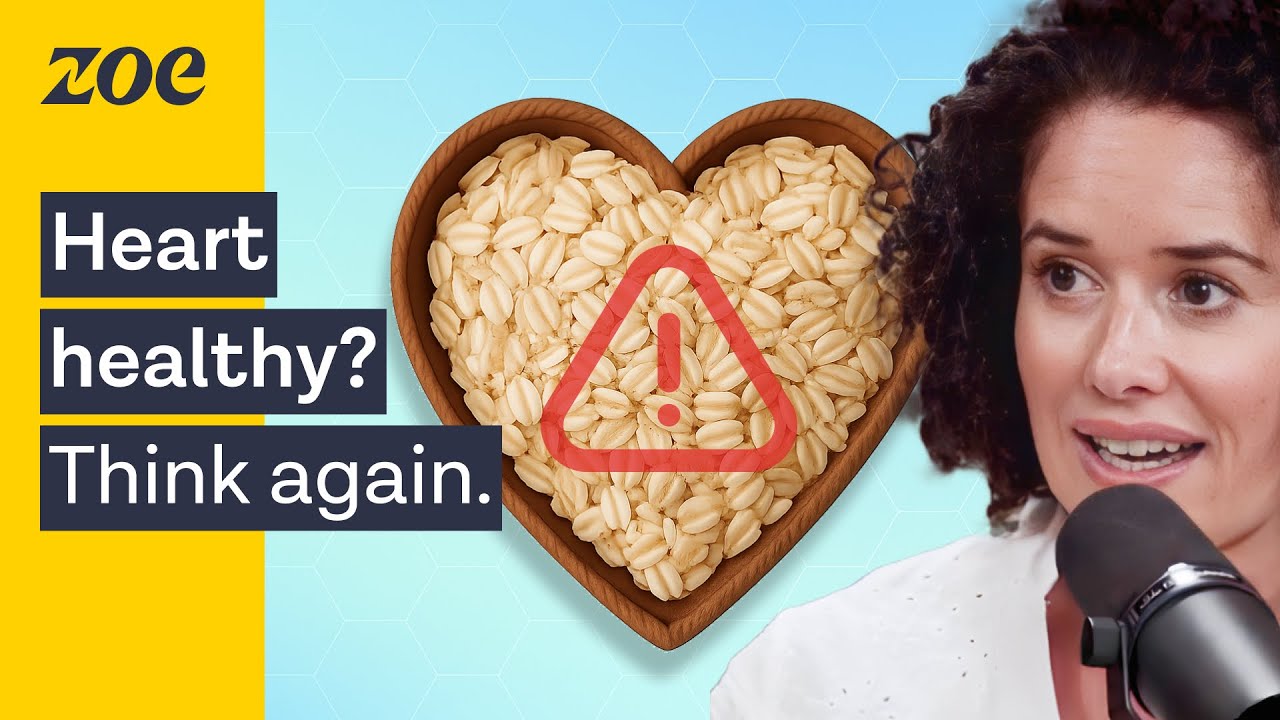
The episode opens with a provocative quick-fire: are heart-healthy labels on oat products lying? The answer: sometimes.
That is not a claim that oats never support heart health. It is a warning that labels can oversimplify.
The heart-health argument rests heavily on beta glucan, a soluble fiber in oats.
Beta glucan can reduce total cholesterol and LDL cholesterol, which is a major causal risk factor for atherosclerotic cardiovascular disease. This is why regulators allow certain health claims when products contain enough beta glucan.
In the episode, the numbers given are:
Regulatory agencies have indeed authorized health claims for oat beta glucan and cholesterol lowering when specific conditions are met. You can read EFSA’s scientific opinion on beta glucans and cholesterol reduction here: EFSA JournalTrusted Source. The US FDA also recognizes soluble fiber from oats as part of a heart-healthy diet pattern, under defined criteria (FDA guidance and qualified health claimsTrusted Source).
This is the investigative twist: a “heart healthy” badge might be technically allowed, but the product could still be highly processed, sweetened, or formulated in a way that spikes glucose for some people.
So the label is not necessarily lying, but it might be incomplete.
The beta glucan paradox, stickiness can help, grinding can hurt
Here is one of the most interesting parts of the episode: processing can worsen glucose spikes, while also changing fiber behavior.
Beta glucans increase viscosity, the gel-like stickiness of stomach and intestinal contents.
That matters because a more viscous mixture can:
The host’s description of instant oats as “wallpaper paste” becomes evidence of beta glucan at work.
Then comes the paradox: grinding can release more beta glucan, increasing that stickiness. So more processed oats might deliver more accessible beta glucan, while also delivering starch faster.
That double-edged sword is why the episode avoids simple rules.
If your main goal is LDL cholesterol reduction, oats may be helpful, but you still might prefer forms that do not send you on a glucose roller coaster.
If your main goal is steady energy and appetite control, the least processed forms, plus toppings, may be the better starting point.
Resource callout: »MORE: If you want to experiment safely, keep a simple food and symptom log for 7 days. Track oat type (steel-cut, rolled, instant), portion (for example, 40 g dry), toppings, and how you feel at 1 hour and 3 hours (hunger, energy, cravings). Patterns show up faster than perfection.
Glyphosate in oats, how to think clearly about a scary headline
The second major controversy is not metabolic, it is chemical.
Glyphosate is a herbicide used in some farming systems, and one use discussed here is as a pre-harvest drying agent (desiccation) to speed harvesting.
This episode’s framing is cautious but not alarmist:
The cancer question is where nuance matters. Glyphosate has been classified by the International Agency for Research on Cancer (IARC) as “probably carcinogenic to humans” (Group 2A). You can read IARC’s overview here: IARC MonographsTrusted Source.
But “probable” is not the same as “proven in real-world dietary exposure at typical levels.” Regulatory agencies set tolerable daily intake limits using conservative assumptions.
In the episode’s view, it is generally hard to reach those limits through normal eating unless someone is consuming very large amounts of oats repeatedly.
This leads to a practical and equitable recommendation: choose organic if it is affordable and accessible, but do not feel that non-organic oats are automatically unsafe.
For readers who want to see how regulators think about pesticide residues, the European Commission explains maximum residue levels and monitoring here: European Commission on pesticide residuesTrusted Source.
Important: If you are pregnant, immunocompromised, or managing a chronic condition, it is reasonable to be extra cautious about food safety concerns. A clinician or registered dietitian can help you weigh tradeoffs without falling into fear-based eating.
How to build an oatmeal that acts more like a meal than a sugar hit
This is where the episode becomes actionable. The “ultimate healthy oatmeal” is not a single recipe, it is a method: reduce rapid starch availability, add buffering nutrients, and account for your own response.
Below is a practical approach that stays faithful to the episode’s logic.
How to choose your oats (start with structure)
How to build the bowl (Pattern A: quick steps + bullets)
A “balanced” oat bowl aims to slow absorption and improve fullness.
A small change, like adding nuts and seeds, can shift not only glucose curves but also how hungry you feel later.
How to test your own response without obsessing
You do not need a CGM to learn from this episode.
Pro Tip: If you love instant oats for convenience, try upgrading the “matrix” rather than quitting. Stir in nut butter after cooking, add chopped nuts, and pair with a protein on the side.
A note on oat milk (and why the episode says “no”)
The quick-fire round includes: “Is oat milk as healthy as some people think?” The answer given is “no.”
The reasoning implied by the rest of the discussion is that oat milk is often a more processed form of oats, with less intact structure and sometimes added oils, stabilizers, or sugars. Many oat milks can behave more like a refined carbohydrate beverage than a whole grain.
That does not mean oat milk is never appropriate. It means it should not automatically inherit the health halo of whole oats.
If you rely on oat milk, check labels for added sugar, and consider how it fits into your overall pattern, especially if you are working on glucose control.
Expert Q&A: Are instant oats always a bad choice?
A: Not necessarily. Instant oats can be a reasonable food, especially when they help someone eat a higher-fiber breakfast instead of pastries or sugary cereal. The issue raised here is that very finely ground, highly processed oats eaten alone can produce a large glucose spike in some people.
A practical compromise is to keep the convenience but add protein, fat, and fiber toppings, and to experiment with less processed oats when time allows.
Prof. Sarah Berry, Professor of Nutrition (as presented in the episode)
Key Takeaways
Frequently Asked Questions
- Are oats bad for you?
- Not as a category. The episode’s framing is that some oat forms, especially finely ground instant oats eaten plain, can cause large glucose spikes for some people, while less processed oats and balanced toppings may be steadier.
- Which oats are best for blood sugar?
- Less processed oats, such as steel-cut and thicker rolled oats, tend to produce a lower rise than finely ground instant oats. Pairing oats with protein, fat, and fiber toppings can also reduce and slow the glucose peak.
- Do oats really lower cholesterol?
- Oats contain beta glucan, a soluble fiber with strong evidence for lowering LDL cholesterol when consumed in sufficient amounts. Regulators like EFSA have authorized cholesterol-related health claims for oat beta glucan under specific conditions.
- Why did two people have different glucose responses to oats?
- Meal composition mattered, one bowl included nuts, seeds, dried berries, and nut butter, which can slow absorption. Individual factors like sleep, stress, time of day, and biology can also change glucose responses.
- Should I buy organic oats because of glyphosate?
- Organic oats can reduce glyphosate exposure if they are affordable and accessible. The episode’s view is that typical dietary exposure is generally low and regulated, so non-organic oats are not automatically unsafe for most people.
Get Evidence-Based Health Tips
Join readers getting weekly insights on health, nutrition, and wellness. No spam, ever.
No spam. Unsubscribe anytime.