How to Eat in 2025: 7 Tips From Spector and Berry
Summary
This 2025 nutrition reset, shaped by Prof. Tim Spector and Prof. Sarah Berry, focuses less on perfect dieting and more on changing the food environment around you. The core ideas are to cut ultra-processed foods, shrink your eating window (often to about 10 hours), stop chasing calories and instead support appetite signals, be mindful with drinks, prioritize plant diversity (aiming for 30 plants per week), stop stressing about protein, and snack smarter. The unique ZOE lens is that your gut microbiome responds quickly, sometimes within weeks, and those changes may influence energy, mood, and cravings.
Why food choices matter more than ever in 2025
Diet is not the only pillar of health, sleep, stress, and physical activity matter too. But this 2025 approach argues that food is the easiest lever to pull first, because it is a daily decision you can influence at almost any age.
The urgency is not subtle.
In the UK and US, the discussion highlights that roughly 60% of adult calories can come from ultra-processed foods, and the share is even higher in many children. The framing is blunt: the modern food landscape is built to push you toward choices that make you hungrier, more snack-prone, and less metabolically resilient over time.
What makes this perspective different from generic “eat better” advice is the emphasis on two underappreciated drivers:
Did you know? The video notes that in the UK and US, about 25% of daily energy can come from snacks, and around 30% of people snack after 9:00 pm. That timing matters as much as the snack itself.
There is also a motivating claim: improving diet even later in life can still matter. Large-scale modeling research has estimated that shifting from a typical Western pattern toward a healthier pattern could add years of life expectancy, including for older adults, although the exact number depends on baseline health and the diet change itself (PLOS MedicineTrusted Source).
The point is not to chase immortality. It is to increase health span, the years you feel well.
Tip 1: Reduce ultra-processed foods (UPFs), start with the “soft texture” trap
Ultra-processed foods are described here in a very practical way: foods that are industrially formulated, often with long ingredient lists, additives, emulsifiers, sweeteners, and a structure that no longer resembles the original food.
Think: chocolate spreads, cookies, cakes, crisps, frozen pizzas, ice cream, many ready meals, and a lot of fast food.
Why UPFs are not just “treats”
Yes, these foods often contain more sugar, saturated fat, and salt, and less fiber. But the unique angle in the conversation is that texture and structure may be a major mechanism.
Softer, highly processed textures can be eaten far faster. The discussion cites research observations that people can eat ultra-processed meals much more quickly than minimally processed equivalents, and that faster eating is linked with higher intake. This lines up with controlled feeding research where diets high in ultra-processed foods led to increased calorie intake and weight gain, even when meals were matched for presented nutrients (Cell Metabolism, Hall et al.Trusted Source).
The metaphor is memorable: these foods can function like “adult baby food”, requiring less chewing, giving the brain less time to register fullness.
Chewing becomes a strategy. The video even jokes that “mastication” is the word of the year.
How to spot UPFs without memorizing a classification system
This is not presented as a purity test. It is a reduction strategy.
Pro Tip: If you want one simple behavior change, pick foods that force you to chew. Crunchy vegetables, whole fruit, nuts, seeds, and intact whole grains are a built-in speed bump.
A realistic target
Eliminating UPFs completely can be unrealistic for many people. The video’s practical stance is to reduce your UPF intake by half as a meaningful first milestone, not a moral identity.
What the research shows: Many studies link higher ultra-processed food intake with worse health outcomes, including cardiometabolic risk. Much of this evidence is observational, so it cannot prove causation on its own, but the overall pattern has been consistent across populations (BMJ systematic reviewTrusted Source).
Tip 2: Give yourself an eating window (aim for 10 hours, not perfection)
An eating window is simply the time between your first and last “eating event” of the day.
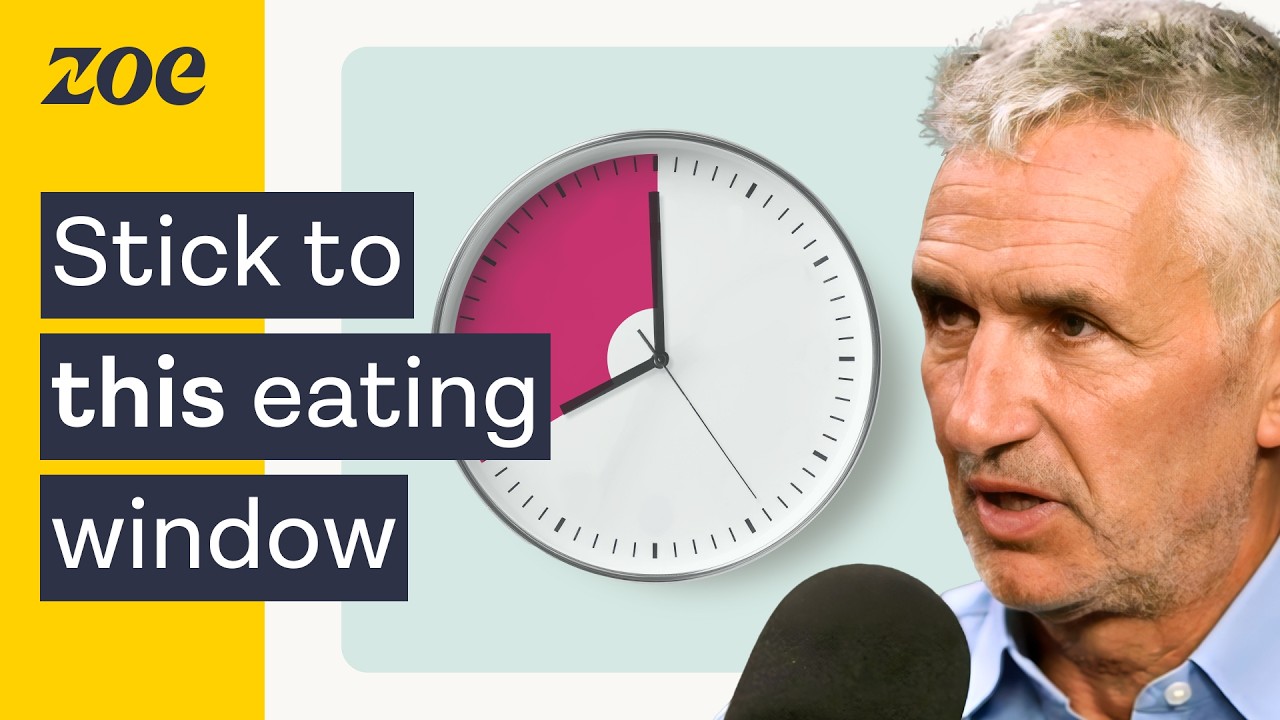
The video notes that in the US the average eating window is around 16 hours, for example eating from 7:00 am to 11:00 pm. The argument is that this pattern, especially late-night eating, is not ideal.
This tip is not pitched as extreme fasting.
It is pitched as a gentle reset: reduce to about a 10-hour eating window, or even 12 hours if that is what you can sustain.
Why this approach is framed as doable
Older time-restricted eating studies often used very tight windows, like 6 hours, which can be socially difficult and miserable. The video highlights newer large-scale work, including a ZOE study in a very large cohort, suggesting that 10 hours may still provide benefits, including improved energy, mood, hunger, and often weight reduction.
The proposed mechanism is partly practical, you stop late-evening grazing that is often boredom-driven.
It is also biological.
The gut and metabolism are framed as needing an overnight “rest period”. The discussion describes a kind of “night shift” in the gut, where different microbial activities support the gut lining and barrier function when you are not constantly feeding the system.
How to try it without turning it into a rigid rule
A good eating window is the one you can repeat.
One important nuance is personalization. Some people find 10 hours easy, others find 12 hours more realistic.
Important: If you are pregnant, have a history of eating disorders, have diabetes that uses insulin or other glucose-lowering medications, or have medical conditions that make fasting risky, it is worth discussing time-restricted eating with a clinician first. Adjusting meal timing can change blood sugar patterns.
About scary headlines
The conversation addresses media coverage of an American Heart Association conference abstract that suggested potential harms. The critique is that conference abstracts can be preliminary, and that single observational findings can be amplified as clickbait.
A better approach is to weigh the totality of evidence, and to choose a moderate, sustainable window.
Tip 3: Calorie counting is dead, appetite biology is not
This perspective is not saying calories do not exist.
It is saying calorie counting is a poor long-term strategy for most people, because the body adapts.
The argument is straightforward: when you cut calories aggressively, many people experience a combination of reduced energy expenditure (the body “burns less”) and increased appetite signals. Over time, the plan becomes harder to maintain, and weight regain becomes common.
This is consistent with long-term weight loss research showing that weight maintenance is challenging and that biological adaptations can promote regain after weight loss (NIHTrusted Source).
Why GLP-1 drugs changed the conversation
A major part of the video’s “2025” framing is that GLP-1 receptor agonists (medications used for type 2 diabetes and obesity) have shifted attention from willpower and calorie math toward satiety, the brain’s fullness signaling.
The discussion emphasizes that these medications act on appetite centers, helping people feel full sooner, reducing cravings for ultra-processed foods, and making it easier to eat less.
But it is not presented as a universal solution.
Resource callout: Want a practical food-quality checklist for when appetite is low, including on GLP-1 medicines? Build a “small plate, high nutrition” template: protein-rich whole foods, high-fiber plants, and healthy fats, then review it with a registered dietitian.
“You cannot out-inject a bad diet”
A key point is that even if appetite is reduced, food quality still matters.
If you eat much less, you can accidentally reduce intake of fiber, micronutrients, and overall protein. That can increase the risk of nutrient shortfalls.
If you are using GLP-1 medicines, it is worth discussing nutrition with a clinician, especially if you have persistent nausea, reduced intake, or rapid weight loss. For safety information and side effects, see FDA prescribing information pages such as for semaglutide products (FDATrusted Source).
Tip 4: Mindful drinking, the hidden sugar and “donut coffee” problem
This tip is not only about alcohol.
It is about recognizing that drinks can quietly become a large portion of daily energy intake.
The video cites that in the US, drinks can account for about 18% of energy intake, and that more than half of added sugar may come from drinks.
That is why this is framed as a high-leverage change.
One swap can matter.
Coffee and tea, the “good news” with a catch
Plain coffee, like an Americano style drink without added sugar and cream, is described as consistently associated with lower risk of mortality in observational studies, often with the strongest signal around 3 to 4 cups per day.
This aligns with large observational analyses suggesting moderate coffee intake is associated with lower risk of death and some cardiometabolic outcomes, though these studies cannot prove coffee causes longer life (BMJ umbrella reviewTrusted Source).
But the catch is important: coffee-shop drinks can become dessert.
A large flavored latte with syrups and creams may carry hundreds of calories, and it is unlikely to deliver the same benefit profile seen with plain coffee.
The microbiome angle on coffee
The video highlights ZOE research suggesting that coffee intake is linked with specific gut microbes, including a microbe strongly associated with coffee consumption.
The practical takeaway is not that you need to chase a specific bacterium. It is that polyphenols in coffee and tea may feed certain microbes, and microbial metabolism may be one pathway linking these drinks to health.
What to drink more of in 2025
The discussion suggests shifting away from sugary drinks and toward options that either have minimal added sugar or may support gut health.
Quick Tip: If you like kombucha, choose one with low added sugar and treat it like a food, not unlimited hydration.
A note on non-sugar sweeteners
The video expresses caution that artificial sweeteners may have negative health effects, potentially mediated through the gut microbiome. The evidence base is still evolving and can vary by sweetener type, dose, and individual response.
If you rely on diet drinks to reduce sugar, consider gradually stepping down sweetness overall, rather than swapping sugar for intense sweeteners indefinitely.
Tip 5: Eat more plants (30 per week), and you can still eat meat
This approach is not “go vegan or fail”.
It is “make plants the majority of your plate, repeatedly, with variety”.
The flagship target is 30 different plants per week. Importantly, “plants” includes not only fruits and vegetables, but also nuts, seeds, legumes, whole grains, herbs, and spices.
Why 30 plants is not just a social media challenge
The argument is rooted in gut microbiome diversity. The concept came from citizen-science style microbiome projects that found people reporting higher plant diversity tended to have more diverse gut microbiomes.
Diversity is treated as valuable because different microbes specialize in different fibers and polyphenols. A more diverse microbial community can produce a broader range of metabolites.
This fits with broader nutrition science that emphasizes dietary patterns rich in minimally processed plant foods and fiber for cardiometabolic health (American Heart Association dietary guidanceTrusted Source).
You can still eat meat, the trade-off framing
Instead of “meat is evil” versus “plants are weak”, the video pushes a replacement question:
What is meat replacing on your plate?
If a huge steak crowds out vegetables, legumes, and whole grains, plant diversity drops.
The stance on meat is nuanced:
This is a middle-ground model: more plants, less meat, and especially less processed meat.
How to hit 30 plants without feeling like you live on lentils
This is where the “action-oriented” part matters. You do not need a new personality, you need a few repeatable tactics.
Pro Tip: Count “different plants” by type, not by color. Red onion and white onion count as one. Black beans and chickpeas count as two.
Tip 6: Stop worrying about protein, worry about fiber and food quality
Protein is having a marketing moment.
The video’s stance is that for most people, protein is not the limiting nutrient, and that the “protein crisis” narrative is being used to sell ultra-processed bars, shakes, and fortified snacks.
A punchy contrast is offered: many people are getting about double the recommended protein intake, while 95% of people are not getting enough fiber, and average fiber intake can be closer to what is recommended for a young child.
Fiber is framed as the true public health gap.
When protein attention might still matter
This is not a blanket statement.
Protein focus may be relevant if you are:
For most others, the practical message is to get protein from real foods, including plant sources.
Plant proteins that also help you reach fiber goals
This is where the trade-off is favorable: many plant protein sources bring fiber and polyphenols, not just amino acids.
The point is not to ignore protein. It is to stop letting protein marketing push you toward ultra-processed products.
What the research shows: Higher dietary fiber intake is consistently associated with better cardiometabolic outcomes in large studies, and increasing fiber is a common feature of dietary patterns linked with improved health (Harvard T.H. Chan School of Public HealthTrusted Source).
Tip 7: Snack smarter, do not let snacks undo your meals
Snacking is framed as normal, not shameful.
The key claim is: snacking itself is not the problem, what you snack on is the problem.
In the UK and US, snacks can provide about a quarter of daily energy. That means snacks are not a minor detail, they can make or break the overall diet pattern.
The “healthy meals, unhealthy snacks” trap
A lot of people eat decent meals and then default to ultra-processed snacks.
This tip argues that swapping snacks is one of the simplest changes because snacks are often more under your control than family dinners or workplace lunches.
A ZOE trial described in the video compared typical snacks to nuts, and observed meaningful improvements in cardiometabolic risk markers over weeks, with an estimated large reduction in predicted cardiovascular risk.
Nuts are also supported by broader evidence linking nut intake with cardiovascular benefit in observational studies and trials, likely due to unsaturated fats, fiber, and polyphenols (American Heart Association on nutsTrusted Source).
Timing matters as much as content
Late-night snacking is singled out.
Even if the snack is “healthy”, snacking after 9:00 pm is associated with less favorable outcomes in the video’s discussion. This also ties back to the eating window idea.
Snack smarter, a practical playbook
Important: If you have diabetes or take medications that affect blood sugar, changing snack timing can change glucose patterns. Consider monitoring your response and discussing changes with your clinician.
The ZOE thread running through all seven tips: your gut microbiome changes fast
The microbiome is not treated as a futuristic add-on here. It is treated as a practical reason that diet changes can feel different quickly.
The video highlights that within a few weeks, people can see measurable changes in their gut microbes, especially if they are starting from a very low baseline of plant foods and a high baseline of ultra-processed foods.
That matters because gut microbes produce metabolites that interact with the immune system and nervous system.
A key claim is that some of the near-term benefits people report, like better mood, more energy, fewer cravings, may be mediated through microbial shifts and reduced exposure to ultra-processed food effects.
This is an active research area. Many microbiome associations are still being mapped, and not all findings translate into clear clinical actions yet. But the practical guidance remains consistent: feed your microbes with diverse plants, and reduce ultra-processed foods that may disrupt appetite and gut signaling.
Seven foods to add in 2025 (plus one “enjoyment” slot)
The episode closes with a concrete list. It is intentionally not a perfect diet plan.
It is a set of “additions” that fit the overall themes: plants, fermentation, healthy fats, and enjoyment.
Tim Spector’s three additions
Sarah Berry’s three additions
The extra item mentioned: a plant diversity supplement
The conversation also mentions ZOE’s Daily30 supplement as a way to add plant diversity. If you use any supplement, it is worth treating it as an addition, not a replacement for a varied diet, and checking it fits your health needs and budget.
Quick Tip: If you want the “enjoyment slot” to support your goals, make it specific and bounded, for example one square of dark chocolate after lunch, rather than grazing late at night.
Key Takeaways
Frequently Asked Questions
- What is the easiest first change if I feel overwhelmed?
- Start by reducing ultra-processed foods in one daily “slot”, like swapping a packaged snack for nuts or fruit. This approach is easier than changing every meal at once and still aligns with the video’s biggest lever.
- Do I need to do a strict 6-hour fasting window to see benefits?
- No. The video emphasizes that a 10-hour eating window, and even 12 hours for some people, may still be beneficial and far more sustainable than extreme windows.
- Is snacking unhealthy?
- Not necessarily. The key points are snack quality and timing, choosing whole-food snacks like nuts, fruit, or vegetables, and avoiding late-night snacking after about 9:00 pm.
- Are GLP-1 weight loss drugs a replacement for healthy eating?
- The video argues they are not. Even with appetite reduction, you still need nutrient-dense foods to meet fiber and micronutrient needs, and it is important to use these medications under medical guidance.
- Do I need to stop eating meat to improve my gut health?
- No. The emphasis is on increasing plant diversity and reducing processed meats, while allowing small amounts of unprocessed meat if you enjoy it and it fits your overall diet pattern.
- Should I be worried I am not getting enough protein?
- Most people likely do not need to worry, according to the video’s framing. If you are older, frail, ill, restricting calories, or following a vegan diet with low intake, discussing protein needs with a clinician or dietitian can be helpful.
Get Evidence-Based Health Tips
Join readers getting weekly insights on health, nutrition, and wellness. No spam, ever.
No spam. Unsubscribe anytime.